
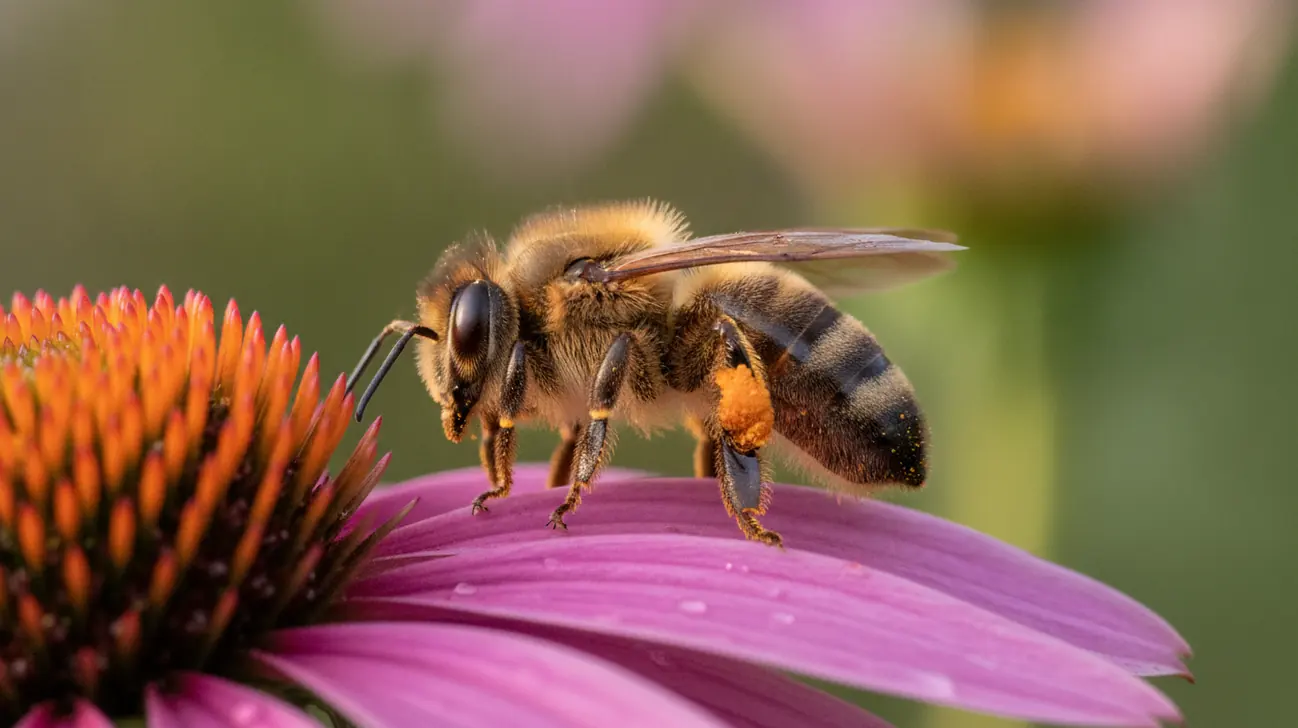
Bee or wasp in a photo? The visible differences
Start with the body, not the color. Extension guides from Cornell and Montana State lean on a handful of physical traits you can see even in a phone photo.
- Fuzz. Bees usually look fuzzy because they carry many branched hairs. Wasps are generally smoother and shinier.
- Pollen. Yellow dust packed on the hind legs or under the abdomen strongly points to a bee.
- Waist. Wasps commonly have a narrow pinched waist, called a petiole. Bees have a broader join between thorax and abdomen.
- Wings. Bees and wasps have four wings. Flies have two.
- Antennae. Bees and wasps have long antennae. Flies usually have short, stubby ones.
Behavior adds a hint. A bee working a flower and gathering pollen is acting like a bee. A wasp may sip nectar, but it generally lacks the structures bees use to carry pollen.
Why yellow and black stripes do not settle it
Bees, wasps and flies can all wear yellow and black. Color alone is the most common reason people get it wrong, and calling every striped insect a honey bee is the classic slip.
Flies are the sneaky ones. Some mimic stinging insects, but a fly has one pair of wings and short, stubby antennae. If you count two wings and see stubby antennae, you are not looking at a bee. If it turns out to be none of these, a general bug identifier is the next stop. A fuzzy, banded larva belongs with identifying a caterpillar from a photo, and anything with eight legs is a case for a spider identifier.
Photo quality causes its own errors. Overlapping wings can hide the second pair. A blurry shot, or one taken from straight above, can make a waist look narrow or hide it completely. Count wings and check the waist only in a sharp image.
Honey bee, bumble bee, paper wasp and fly compared
Size helps when you have a scale. The University of Illinois safety guide gives typical lengths for the three insects people meet most.
| Insect | What to look for |
|---|---|
| Honey bee | Hairy, usually golden-brown with darker bands. About 1/2 to 5/8 inch long, roughly 12.7 to 15.9 mm. |
| Bumble bee | Larger and very hairy, commonly black with yellow or orange bands. About 1/2 to 1 inch, roughly 12.7 to 25.4 mm. |
| Paper wasp | Smoother and narrow-waisted, commonly brown with yellow or reddish markings. About 5/8 to 3/4 inch, roughly 15.9 to 19.1 mm. |
| Fly that mimics a bee or wasp | One pair of wings instead of two, and often short, stubby antennae. |
| Carpenter bee | A bee that can look like a bumble bee. Telling them apart needs clear views of the abdomen and face, plus your location. |
| Sweat, leafcutter, cuckoo or metallic-green bee | Size, hair placement, pollen location, color and range all matter. One distant photo may not be enough. |
Shooting an insect so a bee identifier can use it
Better photos beat better guessing. Work from a safe distance and never crowd the insect.
- Shoot from above, from the side and, if you can do it safely, from the front.
- Put a ruler or other scale object nearby, but never beside an insect that looks defensive.
- Write down the state or province, city, date, habitat and the flower it was visiting.
- Check the body for fuzz and the hind legs and underside for pollen.
- Count wings, keeping in mind that overlapping wings can hide a pair.
- Look at the waist, antennae, abdomen pattern, face and legs.
Photograph the face and legs as well as the back. Wing veins, face shape and leg structure are often what separates two similar bees. Noting the flower helps too, and identifying the plant from a picture gives you a second clue about which bee visits it, while a guide to diagnosing plant problems can tell you whether the insects on a sick plant are the cause.
Got a sharp image? Add it to the upload box and see what comes back. Once the insect is sharp in frame, drop the file into the upload box at the top. The AI names a likely bee or wasp and rates its own certainty, and you still need to check that answer against the clues here.
Where a single photo runs out
A photo supports bee, wasp, fly or a broad bee group far more often than an exact species. The WiBee beginner guide works the same way, sorting bees into five broad groups: honey bee, bumble bee, large dark bee, small dark bee and metallic green bee.
Species-level calls need more. Location, date, size, behavior and close-ups all feed into it. The University of Minnesota organizes its bee identification material into 24 bee entries and 9 wasp entries, which gives you a feel for how many look-alike groups exist even before you reach species.
So treat any result, from a person, a site or software, as tentative. It becomes firmer when the image shows the diagnostic features and a qualified expert agrees.
Guides and tools that help confirm a bee ID
The University of Minnesota Bee Lab recommends iNaturalist for bees, wasps, flies and plants. You upload photos and receive computer-generated and community suggestions. It makes a good second opinion after your own checks.
Regional extension guides are the other solid check. Minnesota, Cornell, Montana State, Colorado State and Pollinator Partnership all publish image-based or character-based guides. Match your photos using location, scale, season and anatomy, not color alone. If you want a quick first pass on anything you find outdoors, the site's tool for identifying things from a picture covers insects and much more.
For species-level certainty, pest problems, conservation records or legal paperwork, ask a taxonomist or extension entomologist in your area.
Staying safe around bees and wasps
A photo ID is never enough to decide what to do about a nest or a sting. Stings can cause life-threatening reactions in people and, in some cases, pets with allergies, according to Cornell. If anyone has an allergic reaction after a sting, get medical or veterinary help right away.
Keep your distance. Do not handle, trap, swat or approach a nest for a better shot, and if you also spot a small crawling bite hazard on your skin, our guide to identifying a tick can help. Honey bees may sting defensively near colonies, and a honey bee that stings can lose its stinger and die. Wasps can be territorial and may sting when provoked.
Do not use an ID result alone to remove a nest or apply pesticide. Call your local extension office or a licensed professional first. Before posting a photo publicly, crop out faces, house numbers and license plates, and check whether your upload shares location data.
Bee or wasp? The errors that trip people up
- Going by yellow and black alone.
- Skipping the wing count, or counting only one pair when the second is hidden.
- Trusting a waist you cannot see clearly.
- Leaving out the location and date.
- Guessing size without a reliable scale.
- Putting a price, rarity or conservation status on an insect before the species is confirmed.
Questions about bee identifier
How can I identify my bee?
Check for fuzzy hair, pollen on the hind legs or underside, a broad waist and four wings. Add location, date and a size reference, then compare with a regional extension guide.
Do wasps have hairy bodies like bees?
Most wasps look smooth and shiny with a narrow waist, while bees are usually fuzzy and often carry pollen on their legs.
Which free app can identify a bee from a photo?
The University of Minnesota Bee Lab recommends iNaturalist for identifying bees, wasps and flies. You upload photos and get computer-generated and community suggestions to compare with your own checks.
How can you tell a bee from a wasp in a photo?
Bees usually look fuzzy, carry pollen and have a broader waist. Wasps are generally smoother and shinier with a narrow waist and no pollen-carrying structures.
Can you identify a bee by its yellow and black color?
No. Bees, wasps and flies can share yellow-and-black banding, so color alone misleads. Use fuzz, waist, wing count, antennae and pollen instead.
How many wings does a bee have?
Bees have four wings, in two pairs, as do wasps. Flies have only one pair. Overlapping wings can hide the second pair, so use a sharp photo.
How big is a honey bee compared with a bumble bee?
The University of Illinois safety guide lists honey bees at about 1/2 to 5/8 inch and bumble bees at about 1/2 to 1 inch, so bumble bees run larger.
Sources
- University of Minnesota bee identification resource
- University of Minnesota Bee Lab, bee ID
- WiBee app bee ID guide
- University of Illinois, bee and wasp safety
- Montana State University Urban IPM, Montana bee ID
- Cornell, identifying bees and wasps
- Pollinator Partnership, Bee ID safety guide
- Cornell, bees and wasps