
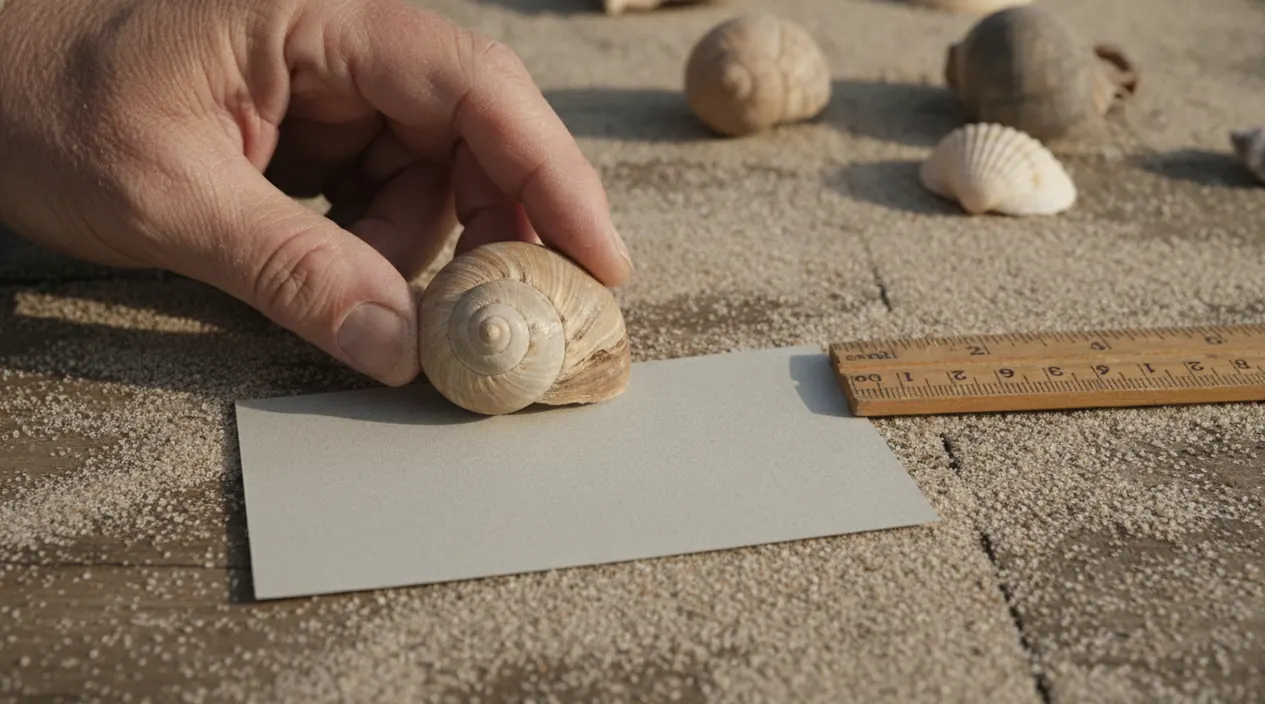
Start by sorting snail shells from clam shells
The first split saves the most time. A gastropod is a single coiled shell with an opening, the aperture. A bivalve is a pair of valves joined by a hinge. If you hold one half of a clam and the other half is gone, look at the hinge. Teeth and ligament scars there matter more than anything on the outside.
Other things look like shells and are not. Coral, tube worm casings and mineral lumps can fool you. Real shells show growth lines and an organized aperture or hinge. A mineral usually has a crystalline surface and no molluscan architecture, and our guide to identifying crystals and gemstones can help you check. If your find looks more like stone, our rock identifier page covers that side.
Shell traits that narrow the name
Color is the feature people notice and the one that misleads most. Sun, surf and time bleach shells. Work through the structure instead.
- Overall form. Spiral, cone, turreted, ear-shaped, cowrie-like, flattened or irregular.
- Aperture. Its shape and position, the thickness of the lip, any teeth or folds, and whether a siphonal canal extends from the base.
- Spire. How tall it is, how many whorls it has, and whether the whorls have shoulders.
- Sculpture. Ribs, knobs, cords, grooves, keels, spines, growth lines or a crosshatch pattern.
- Surface. Glossy, chalky, worn, eroded, or covered in a thin skin called periostracum.
- Pattern. Bands, spots, zigzags, radial rays, and the color inside the lip.
- Size. Maximum length, width and height, measured with a ruler.
Condition counts too. A beach-worn, broken, drilled or bleached shell has lost the details a name depends on. A juvenile can also look unlike its adult form.
Setting up a shell photo for the best result
Most bad IDs start with one bad photo, usually the top of the shell on a sandy towel. Do this instead.
- Place the shell on a plain, nonreflective background.
- Lay a ruler along the shell so real size shows.
- Shoot separate views of the aperture, the back, the spire, the hinge, the interior and the underside.
- Use diffuse daylight. Skip flash glare and heavy filters.
- Measure the length, width and height, and write the numbers down.
- Note the exact beach, the date, the habitat, the tide zone and whether the shell was occupied.
Estimating size from a photo is unreliable, which is why the ruler goes in the frame. The locality note does as much work as the picture, because range rules out many lookalikes.
Shells that get confused with each other
| Pair | What separates them |
|---|---|
| Conch and whelk | Conchs commonly have a broad, flared outer lip. Whelks usually have a narrower lip and a more pronounced siphonal canal. The exact species still depends on locality and shell details. |
| Scallop, ark and cockle | All can have radial ribs. Hinge shape, valve symmetry, ear-like extensions and rib texture separate them. |
| Cowrie and a glossy lookalike | Cowries usually have a highly polished shell and a long toothed aperture. Juveniles and unrelated glossy shells can resemble them. |
| Auger and turret shell | Both are elongated spirals. Augers are typically slender and sharply tapered. Turret shells often have stronger whorls or sculpture. |
Notice that every row relies on structure, not color. That habit is the whole skill.
What a seashell identifier app can and cannot tell you
Photo-based apps return a likely name. Some also give scientific names, habitat information, confidence scores, collection logs and identification histories, according to one Google Play listing. Others advertise offline access and beach guides. One store listing claims a database of more than 1,000 verified shell species, but that is the provider's own claim, not an independent count.
The limit is simple. A single worn shell photographed from one angle usually cannot be pinned to a species with certainty. A good seashell identifier narrows the field, and a confidence score is a hint rather than proof. Never assume the top result is right. Compare the leading candidates on aperture, sculpture, hinge, lip, spire and locality, then check a regional field guide.
Some apps also advertise rarity or market-value estimates. A photo cannot give you a reliable price. Condition, provenance, legality, species, locality and buyer demand all move the number. If value matters, a dealer or a shell club can tell you more than an app badge.
Check for a living animal and the beach rules first
A shell with an animal, an operculum, tissue or a hermit crab inside is not empty. Leave it where it is. Movement, odor or a hermit crab claw poking out all mean the shell is occupied. Hawaii, for example, prohibits collecting shells with living organisms, along with large quantities, according to Outdoor Guide.
Rules differ by beach, land manager, country, species and quantity. No single rule covers every U.S. beach. Padre Island National Seashore lets visitors keep up to one U.S. gallon, or 3.79 liters, of seashells and sea beans, and it prohibits commercial collecting. Federal fishery rules for queen conch in the Caribbean may add seasons, minimum sizes and bag limits. Read the posted signs and ask the managing agency before you pocket anything. Private land is its own question, and owner permission is separate from identification.
Wash your hands after handling beach finds. Watch for sharp fragments and polluted debris. If you post photos publicly, strip the GPS data first, and do not publish exact spots for rare finds. Beaches hold other things worth a photo too, such as a found feather or a line of tracks in the sand.
Shell naming errors to watch for
- Going by color alone.
- Ignoring geographic range.
- Photographing only the top of the shell.
- Leaving out a ruler.
- Mistaking a worn adult for a juvenile.
- Treating an eroded shell as if it kept its original form.
- Skipping the aperture, hinge, teeth or siphonal canal.
- Recording a common name without the date, locality and how sure you are.
Label each find as possible, probable or confirmed. Keep the original photos and your provenance notes with the specimen. A shell with a note beats a shell in a jar of unlabeled mystery.
Where to take a shell you still cannot name
Local shell clubs and malacologists handle unusual, worn or regionally restricted specimens well. Museum and university collections hold confirmed specimens for comparison, so look for the one that covers your coastline. Go to an expert when the answer affects legality, sale, conservation or a scientific label. For a first pass on any find, identifying things from a picture is a fast way to get a starting name before you dig into guides.
Questions about seashell identifier
How do I identify a seashell from a photo?
Photograph the aperture, back, spire and hinge on a plain background with a ruler. Add where you found it, then compare candidates by structure and range, not color.
Can an app accurately identify a seashell?
Apps give a likely name and sometimes a confidence score, but a photo alone rarely proves a species. Take the result as a pointer, then verify it in a field guide for your coast.
What features matter most when identifying a shell?
Overall form, aperture, spire, sculpture, hinge for bivalves, and measured size matter most. Condition and exact locality narrow the choices more than color does.
How can I tell a conch from a whelk?
Conchs commonly have a broad, flared outer lip. Whelks usually have a narrower lip and a more pronounced siphonal canal. Species still depends on where you found it.
Is it legal to take seashells from the beach?
Beach, land manager and quantity all matter. Padre Island National Seashore allows up to one U.S. gallon, 3.79 liters, but prohibits commercial collecting. Check local rules.
Is there still an animal living in my seashell?
Look for movement, tissue, an operculum, a strong odor or a hermit crab. If any are present, leave the shell where you found it.
Can a photo tell me what a seashell is worth?
No. Value depends on species, condition, provenance, legality, locality and buyer demand. App rarity or price estimates are not proof of market value.
Why does a ruler matter in a shell photo?
Size estimates from photos are unreliable, and size helps separate similar species and juveniles from adults. A ruler beside the shell gives a true scale.