
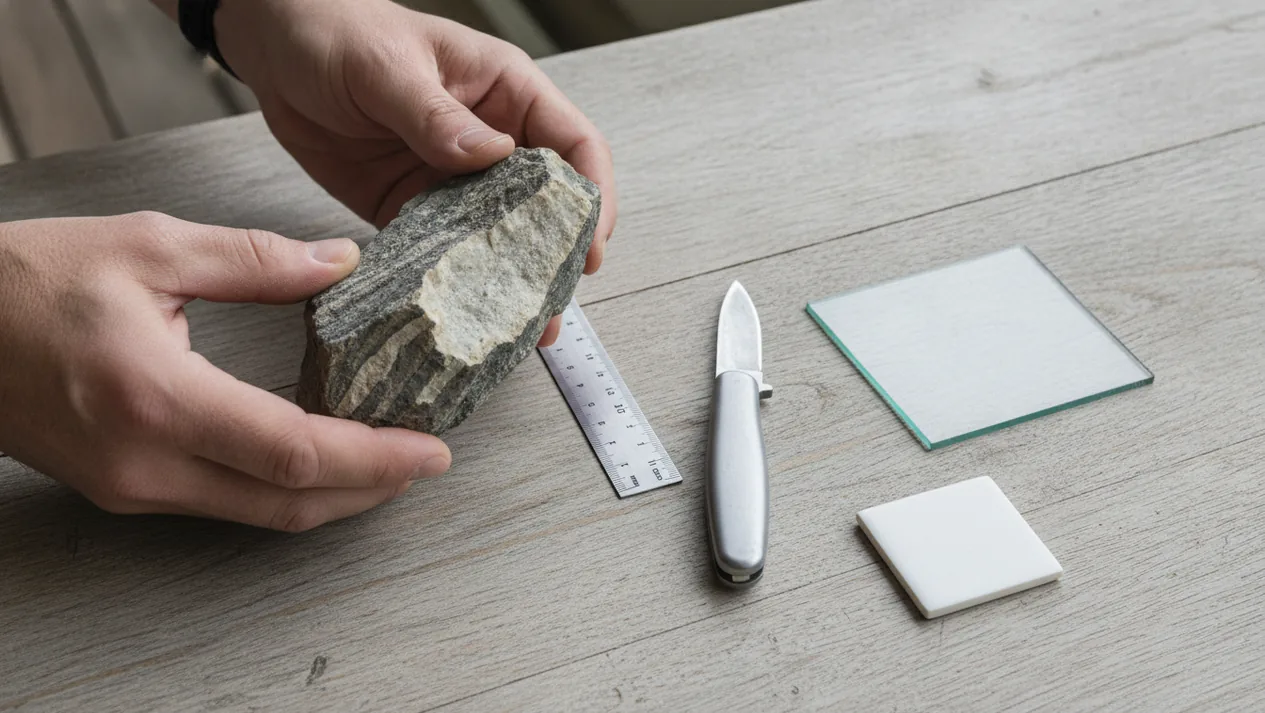
What one photo can and cannot say about a rock
A photo shows color, texture, and shape. It leaves out weight, hardness, streak, and the way a stone breaks, and those properties settle most identifications. The USGS says rocks and minerals are extremely difficult to identify from photographs and should be examined in person from all sides. That is the honest limit of any rock identifier, from an AI scan to a friend looking at your phone.
So treat a photo result as a short list of candidates. Your job is to narrow it with a few checks, and the rest of this page shows which ones. Most need nothing more than a steel pocketknife, a piece of window glass, a magnet, and some patience.
Be clear about what you are asking, too. When people type what is this rock, they often have a mineral in hand. A rock is made of one or more minerals. Quartz is a mineral. Granite is a rock that contains quartz along with other minerals. Mixing up the two names is a common mistake, and it sends you to the wrong reference tables. Sorting a stone into igneous, sedimentary, or metamorphic comes first, and the clues are things you can see, such as rounded holes, layers, and aligned minerals.
Taking rock photos where the details show
Most bad rock photos fail for the same reasons. The stone is weathered on the outside, the light is harsh, and nothing in the frame shows size. Fix those and your result improves before you touch a single test kit.
- Shoot in diffuse daylight, such as a shaded porch or an overcast day. Direct sun washes out grain and luster.
- Photograph every side, including the bottom and any broken surface. A fresh interior surface matters most, because weathering changes the outer color and texture.
- Lay a ruler beside the rock. A photo without scale cannot establish size, and a coin works fine for this, though a collectible trading card can also serve if you use a Pokemon card scanner for identifying cards. If the round metal object turns out to be the more interesting find, our guide to identifying coins by photo picks up from there.
- Take one set dry and one set lightly wet. Wet stone often shows grain and banding more clearly. Skip the wet shot if the sample may dissolve, crumble, contain salts, or be hazardous.
- Write down the place and date of the find, what the surrounding ground looked like, and whether the rock was loose or still attached to bedrock. Locality narrows the options faster than any filter. If a label or sign near the spot has lettering you want to match, try a tool for identifying typefaces from images.
One more habit worth building. Phone photos can carry GPS data inside the file. If you plan to post pictures publicly and the spot matters, strip the location data first.
Visible features that point toward a rock type
Before any testing, read the stone like a page. These are the features that carry the most information in a picture, and what each one suggests.
| What you see | What it suggests |
|---|---|
| Visible interlocking grains | Coarse crystalline rock |
| Grains too small to see | Fine-grained igneous, sedimentary, or metamorphic material |
| Repeated layers | Sedimentary rock or banded metamorphic rock |
| Parallel mineral alignment | Foliation, common in slate, schist, and gneiss |
| Rounded holes | Vesicles from gas bubbles in volcanic rock |
| Shell, plant, or body impressions | Fossils, which point to sedimentary rock |
| Metallic-looking surface | Minerals such as galena, pyrite, or hematite |
| Glassy luster | Common in quartz |
| Repeated flat breaks | Cleavage |
| Irregular or curved breaks | Fracture |
Crystal shape helps with minerals. Cubic, rhombohedral, fibrous, and needle-like forms each narrow the list. Luster is the way light plays on the surface, and it ranges from metallic to glassy, pearly, dull, or earthy. If you find a fossil impression, a shell-like pattern in the stone does not make it a seashell. Our seashell identification page is the better place for specimens that are actual shells.
Color alone is a weak clue. Many unrelated minerals share the same color, so use it to support other evidence, never as the answer.
Home tests that tell rocks and minerals apart
Mineral identification commonly rests on color, streak, hardness, cleavage, form, and specific gravity, according to the USGS bulletin on the subject. You can do three or four of those at a kitchen table. The Kansas Geological Survey lists the basic materials as dilute hydrochloric acid, unglazed porcelain, a steel pocketknife, window glass, and a piece of quartz.
Testing hardness with the Mohs scale
Hardness is how well a surface resists scratching. The Mohs scale ranks minerals from 1 to 10, and the first seven steps are the ones most home testers use.
| Mohs hardness | Mineral |
|---|---|
| 1 | Talc |
| 2 | Gypsum |
| 3 | Calcite |
| 4 | Fluorite |
| 5 | Apatite |
| 6 | Feldspar |
| 7 | Quartz |
Everyday objects give you rough stand-ins. A fingernail is about 2.5, glass is about 5.5, and ordinary steel is about 5 to 5.5. Those values shift with the object and the test conditions, so use them as bands, not exact readings.
Here is how it plays out. Quartz at hardness 7 scratches glass. Feldspar at 6 can scratch glass too. Calcite at 3 cannot. If your specimen leaves a groove in a glass pane, it is harder than glass, and you can rule out a long list of softer minerals.
Test an inconspicuous spot and press firmly. Then wipe the test surface. A powdery streak of the specimen smeared on the glass can look like a scratch, and a real scratch is a groove you can feel with a fingernail. Mistaking one for the other is a classic error. Never test hardness on a surface you want to keep pristine.
Streak, magnetism, and the acid test
Streak is the color of a mineral's powder, usually checked by dragging it across unglazed porcelain. It often differs from the visible surface color, which is why it is so useful. Hematite commonly leaves a red to reddish-brown streak even when the stone looks silvery gray. Only test streak if marking the specimen is acceptable.
A magnet takes ten seconds. Magnetite is strongly magnetic, and that separates it from lookalikes that are not.
Dilute hydrochloric acid is the test for carbonates. Calcite commonly reacts with it, and that is how you separate calcite from quartz and marble from quartzite. This is the one test that can hurt you. The acid can burn skin and eyes and release irritating fumes. Use eye protection and ventilation, follow proper chemical handling, and stop if the sample or the reaction is unclear.
Lookalike pairs that fool beginners
Most wrong IDs come from a handful of repeat offenders. If your stone fits one side of a pair below, run the single test that separates them.
| Pair | How to separate them |
|---|---|
| Granite and gneiss | Granite generally has randomly arranged visible crystals. Gneiss commonly has compositional bands or aligned minerals. |
| Basalt and dark chert | Basalt is commonly fine-grained and may have vesicles. Chert is dense, microcrystalline, and commonly breaks with curved, shell-like fractures. |
| Quartz and calcite | Quartz is hardness 7 and scratches glass. Calcite is hardness 3 and commonly reacts with dilute hydrochloric acid. |
| Pyrite and gold | Pyrite is brittle and commonly forms cubic crystals. Gold is malleable and does not crumble when struck. |
| Galena, hematite, and magnetite | Galena is lead-gray, commonly cubic, and very dense. Magnetite is strongly magnetic. Hematite commonly leaves a red to reddish-brown streak. |
| Marble and quartzite | Marble is mainly calcite and reacts with dilute acid. Quartzite is dominated by quartz and is much harder. |
| Pumice and slag | Pumice is naturally vesicular volcanic rock. Slag is industrial waste and may show glassy surfaces, metal droplets, or unnatural shapes. |
| Obsidian and manufactured glass | Obsidian is natural volcanic glass with curved conchoidal fractures. Manufactured glass may show bubbles, uniform thickness, or cut edges. |
The pyrite pair deserves a second look, because a yellow, shiny stone gets called gold more often than anything else. Yellow and reflective is not a test. Check malleability, streak, density, and composition before you say the word gold out loud. If your find looks more like a polished crystal or a cut stone than a plain rock, our gemstone and crystal identifier page covers that side in more detail.
A caution on the obsidian and glass pair. A smooth black chunk with a curved break is promising, but beach glass, bottle bases, and furnace waste can imitate it. Locality helps here. Obsidian comes from volcanic areas, so a find in a ditch behind a factory points elsewhere, and you may even be looking at a plant, where the weed identifier guide can help.
How a rock identifier app fits with other tools
A rock identifier app takes your photo and returns candidate names. Models, training data, and the way they report confidence differ from one app to the next, and their handling of rocks varies. Read the answer as a hypothesis, not as confirmation, and keep your tests running.
The tool on this page follows that same logic. The AI describes what shows in the picture you sent and answers briefly, with a rating of its own certainty. It does not weigh the stone, scratch it, or know where you found it, so give it your best pictures and then verify what it says.
Some people reach for iNaturalist or its Seek app. Both are built mainly for organisms, not ordinary rocks. Seek gives instant AI-assisted identifications for plants, animals, insects, fungi, and other wildlife, and it does not require an account. iNaturalist says Seek records stay on your device unless you log in and post them. On iNaturalist itself, a posted record can include your photo, location, and time, and it is publicly visible. That is great for a bird sighting and not always what you want for a spot where you found rare minerals. If the thing in your hand turns out to be alive, such as a lichen or a bug that looked like a pebble, try our picture identifier for everything else you find.
Where to take a rock when the photo and tests stall
The USGS gives general guidance and says accurate identification normally requires physical examination. It does not examine specimens for individuals or companies. So you need someone local.
- State geological surveys. They often publish regional mineral tables, field guides, and maps. The Kansas Geological Survey organizes its tables by properties such as streak, color, hardness, and remarks, which makes cross-checking your test results quick.
- Geology departments and museums. They have mineralogists and petrologists, and some host public identification events. Check what your nearest one offers.
- Rock and mineral clubs. Experienced collectors often have testing gear and strong opinions about local finds.
- Laboratories. X-ray diffraction, petrographic microscopy, X-ray fluorescence, and specific-gravity testing can identify composition or mineral phases. Use them when identity, value, or safety carries real consequences.
Send the whole package, not one picture. Include every angle, the scale shot, the location and date, and your notes on color, grain size, layering, luster, cleavage, and fracture, plus the results of your hardness, streak, magnet, and acid checks. A reviewer who gets all that can usually say something useful in a few minutes.
Safety and collecting rules before you break or take a rock
The identification is the easy part. Getting the specimen safely and legally comes first.
- Wear safety glasses, gloves, protective clothing, and hard-toed shoes when breaking or dislodging specimens, as USGS collecting guidance advises.
- Stay away from overhanging rock, unstable slopes, quarry walls, and steep natural walls.
- Work with another person and carry a first-aid kit.
- Cutting, grinding, or breaking silica-bearing rock can create respirable crystalline silica. Use dust controls and respiratory protection.
- Do not taste a mineral or inhale its dust on purpose.
Be careful with strange specimens. A rock that may be radioactive, asbestos-bearing, mercury-bearing, or otherwise contaminated should not be handled, powdered, heated, or moved until a professional has assessed it. If something looks odd and you cannot say why, do not scratch it, grind it, or put it in your pocket.
On the legal side, USGS guidance says collecting rocks in national parks, monuments, and state parks is illegal, and it advises getting permission on private property. Rules differ by country, state, land agency, site, and the kind of specimen, so check the rule for your exact spot before you pick anything up. For rare minerals, fossils, archaeological objects, or sensitive sites, think twice before posting an exact locality.
A photo cannot put a price on a rock
People often ask what their rock is worth in the same breath as what it is. Those are separate questions, and the second depends on the first. A credible price needs a confirmed identity, weight or dimensions, condition, provenance, locality, treatment status, and comparable sales. A single picture supplies none of those. An online identification is not a professional valuation, a mineral analysis, or a safety clearance, and it should not be quoted as one.
If your find is a worked object rather than a natural stone, such as a carved piece or an old tool, our antique identifier guide is the more useful starting point.
How a rock ID ends up pointing the wrong way
- Relying on one photograph, or photographing only the weathered outside.
- Leaving out scale and locality.
- Treating color as the deciding clue.
- Mixing up streak color with the visible surface color.
- Assuming an app's top-ranked result is confirmed.
- Testing hardness on a collectible surface, or reading a smear of powder as a scratch.
- Using acid without eye protection and ventilation.
- Collecting on protected land or private property without permission.
- Quoting a price before identity, provenance, condition, size, and market comparables are settled.
Run through that list the next time a rock stumps you. Nine times out of ten, a second photo of a fresh broken face and one honest scratch test will move the answer further than any amount of scrolling through lookalike images.
Questions about rock identifier
Is there a free rock identifier?
Yes, several free tools give a suggested name from a photo. Treat the result as a starting guess and confirm it with hardness, streak, and acid tests or a local expert.
Will a rock photo be enough to identify it?
You can get a likely name, but a photo rarely confirms it. The USGS says rocks and minerals are extremely difficult to identify from photographs and should be examined in person.
How do I identify what kind of rock I have?
Note color, grain size, layering, luster, and how it breaks. Then test hardness, streak, magnetism, and acid reaction, and compare the results with a state geological survey table.
Can Google identify rocks?
Phone image search and AI tools can offer candidate names, but their training and accuracy vary. Treat any result as a hypothesis and check it with physical tests.
What is the app that identifies rocks?
Several apps offer rock guesses from photos. Seek by iNaturalist is free and needs no account, but it is built for living things, not ordinary rocks.
Does the rock identifier app actually work?
It can narrow the options when the photo is sharp and shows a fresh surface. It cannot replace hardness tests, streak, or an expert, so treat its answer as a suggestion.
How can I tell quartz from calcite?
Quartz has Mohs hardness 7 and scratches glass. Calcite has hardness 3, cannot scratch glass, and commonly reacts with dilute hydrochloric acid.
Is it legal to collect rocks?
USGS guidance says collecting rocks in national parks, monuments, and state parks is illegal. On private property, get permission first, and check local rules for any other site.