
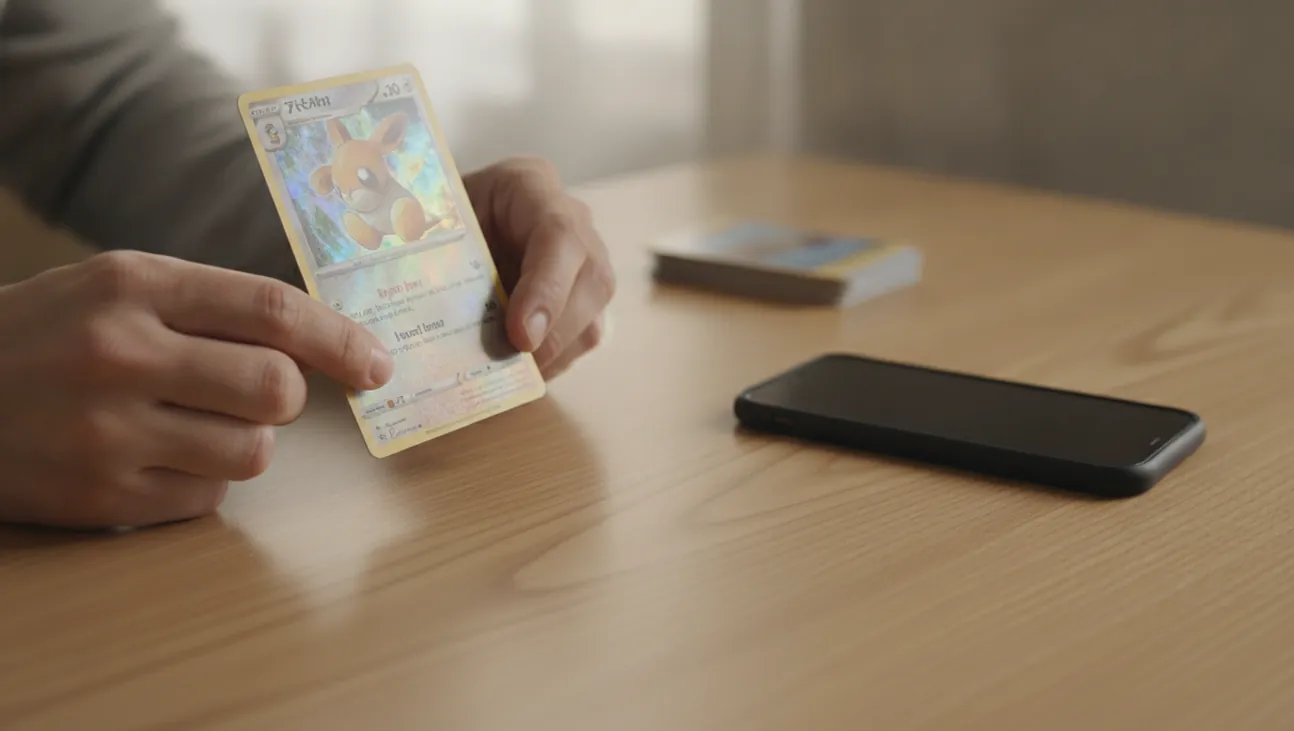
What a pokemon card scanner can tell you from a photo
A card scanner uses your phone camera to match a card's artwork and printed details against a database. CardDex Scanner describes its own app as identifying the card, set, rarity and artist, and other apps add an estimated market price. That is useful. It is also where the promise ends, because a scan is not proof of authenticity or condition, a point Double Holo's 2026 comparison makes too.
This is an independent guide. It has no connection to The Pokémon Company or Nintendo, and it names apps only to explain how they work and what they charge.
To start, put the front of the card in the upload box. It looks at the photo, names the Pokémon when it can, and says how sure it is. It does not look up prices, so use its answer as the starting point for the checks below.
You still need to check by hand because Pokémon artwork repeats across sets, languages and reprints. A match made on the illustration alone can land on the wrong card, and the wrong card carries the wrong price. The habit applies to any collectible you want to identify from a picture. Read the printed details first, then confirm in a reference.
The printed details that identify a Pokémon card
Read these off the card before you trust any match. They are what every good pokemon card identifier relies on, whether it is software or a person behind a shop counter.
- Name and artwork. The character, attack text, HP, type symbol and illustration are the main matching features.
- Set symbol and collector number. The symbol sits near the lower-left or lower-right area. The collector number looks like 123/198. Together they separate cards with near-identical artwork, so write both down.
- Set size. A number such as 25/102 gives the card's position in a set of that size. When the first number is higher than the second, as in 201/198, check the set list for a secret rare version.
- Rarity symbol. Common, uncommon, rare, holo rare, ultra rare and special treatments can look alike in photographs.
- Language. English, Japanese and Simplified Chinese cards can sit in different databases with different prices. DittoDex, for one, lists all three.
- Edition and print markers. The words 1st Edition, shadowless, promo symbols, ex, V, VMAX and VSTAR labels and regulation marks can change both identification and value.
- Holo pattern and texture. Foil orientation, surface texture and parallel-print differences help separate variants.
Condition is a different question. Centering, whitening, scratches, dents, bends, print lines and edge wear all move the price, but one identification scan cannot reliably judge them. You judge those with your own eyes and a good light.
Getting a clean card photo for the scan
Most bad matches start with a bad photo. Glare across the foil, a tilted angle or a thumb over a corner will hide exactly the details a scanner needs. Follow these steps.
- Place the card on a flat, clean, nonreflective surface.
- Photograph the front in even light with the entire card visible.
- Repeat with the back, keeping the camera parallel to the card.
- Write down the Pokémon name, card number, set symbol, language, rarity and any edition or promo marking yourself.
- Run the image through at least one scanner.
- Confirm the result in the Pokémon Trading Card Database or a reputable independent checklist.
- Compare the exact set symbol and collector number. Reject any match that rests on artwork alone.
- Inspect the front, back, edges, corners, surface, centering and holo pattern one at a time.
Holo cards are the hard case. Tilt the card until the glare slides off the artwork, then shoot. If the foil still washes out the number, take a second photo of just the bottom edge of the card.
Pokemon card scanner apps and databases compared
Every app below describes itself in its own listing, and the figures are what each one advertises, not something we have measured. Prices change, so check the current store page before you pay.
| Tool | What it advertises | Cost or limit named in sources |
|---|---|---|
| CardDex Scanner | Database of 10,000+ cards, collection tracking, set goals, market pricing | $2.99 one-time download, needs internet for scanning and pricing |
| CollX | Visual matching against 20+ million cards, pricing based on millions of historical auction prices | Pro tier adds CSV export and marketplace data |
| DittoDex | 70,000+ English, Japanese and Simplified Chinese cards and sealed products | Pro tier adds unlimited scanning and price history |
| PokeScope | Card, set, number, estimated value and graded pricing for PSA, BGS, CGC and others | Premium access needed for unlimited scans |
| Collectr | Collection and price tracking | Pro listed at $7.99 per month or $59.99 per year in a 2026 comparison |
Subscriptions vary a lot. Double Holo's 2026 comparison lists one app's paid tier at $7.99 per week or $24.99 per year. The weekly rate looks small until you add up a year of it. Several apps advertise free scans but keep unlimited scans or advanced pricing behind a paid tier, so read the scan limit, renewal price and cancellation terms first.
Databases do the confirming. The Pokémon Trading Card Database supports searches by card name and keyword. Pokémon Support says nonessential gameplay text is not searchable there, so searching a line of attack text can come back empty even for a real card. TCGdex is an open-source card database with an API, and it states plainly that it is not produced, endorsed, supported or affiliated with The Pokémon Company, Creatures, Game Freak or Nintendo.
Use at least two sources. One app plus one database check catches most wrong matches.
Telling lookalike Pokémon cards apart
Lookalikes cause more wrong IDs than blurry photos do. These are the pairs that trip people up.
- Same Pokémon in different sets. Compare the set symbol and collector number, not only the artwork.
- Holo and reverse holo. Check which part of the card has foil, then match it against the exact set checklist.
- Regular and secret rare. A collector number above the set's stated number, such as 201/198, points to a secret rare.
- Regular, full-art, rainbow, gold, ex, V, VMAX and VSTAR. Compare borders, foil, texture, the card title and the collector number.
- English and Japanese editions. Read the language, then compare the card number and the set database. Prices are not interchangeable.
- Base Set shadowless and unlimited. Inspect the right-side border of the illustration frame and the edition marking. A photograph may not be enough to settle this one.
- Reprints and promos. Check the promo stamp, set symbol, copyright line and collector number.
When two candidates stay tied after all that, assume the more valuable one is not proven. Put the card in front of a local card shop or an experienced dealer, who can examine it in hand and compare recent sales.
Warning signs that a Pokémon card may be fake
No image-only card scanner can guarantee authenticity. The database matches the picture of a card, and a good counterfeit copies the picture. Look at the physical card for these warning signs.
- Blurry text or incorrect fonts, which a font identifier for comparing typefaces can help you check.
- Wrong colors compared with a card you know is real from the same set.
- Abnormal gloss, or missing texture where the card should have it.
- Incorrect spelling anywhere on the card.
- Unusual thickness when you hold it next to a genuine card.
Graded cards add one more check. A graded-card scanner may match a certification number, but a database match does not show that the slab or the card inside is genuine. Compare the physical card, the label and the certification number against the grader's records. PGC states that its database provides case photographs for comparison, which makes it easy to spot a case that does not match.
Checking what a scanned card is worth
An app's estimated value is an estimate. It is not a guaranteed sale price, and it is only as good as the match behind it. Here is a safer order of work.
- Confirm the exact card first. Set symbol, collector number, language and variant must all agree.
- Look up recent sold prices for the same language, variant and condition. Do not use active asking prices, because anyone can ask anything.
- Grade the card yourself, honestly, by checking corners, edges, surface, centering and holo pattern separately.
- For a card that might be valuable, get a second database match and seek professional inspection or grading.
PSA, Beckett/BGS, CGC and other grading companies assess condition and may encapsulate cards. A scanner alone cannot tell you what grade one of them will give. Do not lean on a single app or a single price source either. Two sources that disagree are telling you something.
Until you know what you have, store it properly. Use a sleeve and a rigid holder, and keep the card away from bending, heat, moisture and adhesive contact. Handle it with clean, dry hands.
Mistakes that give you the wrong card or the wrong price
- Scanning only the artwork and ignoring the set symbol and collector number.
- Confusing an active listing with a completed sale.
- Mixing English, Japanese and other-language prices.
- Treating an app's estimated value as a guaranteed sale price.
- Assuming a card identified by software is authentic.
- Ignoring condition, especially whitening, dents, scratches, bends and poor centering.
- Failing to separate holo, reverse holo, promo, first edition, shadowless and reprint variants.
- Photographing under glare, in low light, at an angle or with part of the card covered.
- Using an outdated database that lacks newer sets.
- Paying for a subscription without checking scan limits, renewal price, cancellation terms and export options.
- Placing cards directly on abrasive surfaces or bending the corners while you photograph them.
Privacy, subscriptions and selling rules for card scans
A scan sends a photo somewhere. Before you upload a whole collection, think about where it goes.
- Do not upload high-resolution images that show personal information, addresses, invoices, grading certificates or collection inventories unless you accept the app's privacy terms.
- Check whether the app stores uploaded photos, collection data, device identifiers or account information.
- Install only from an official app store, and verify the developer before you do.
- Avoid posting a valuable card's exact storage location or your full collection value in public.
Selling has its own rules. Describe the card's exact set, number, language, condition and grade accurately, because misrepresenting a card or a grade can lead to marketplace and legal disputes. Pokémon card artwork, names and trademarks are intellectual property. Identifying a card and keeping it in a personal collection gives you no right to reproduce or commercially use them.
When the find is a coin, stamp or antique instead of a card
The same read-first, confirm-second routine works for other collectibles. A coin identifier for dates and mint marks, a stamp identifier for perforations and printing and an antique identifier for makers marks each lean on small printed details, just as a card leans on its set symbol and number.
Questions about pokemon card scanner
What app to scan my Pokémon cards?
Several apps scan cards, including CardDex Scanner, CollX, DittoDex, PokeScope and Collectr. Compare scan limits, supported languages and subscription terms, then confirm any match in the Pokémon Trading Card Database.
How do I value my Pokémon cards?
Confirm the exact card, then check recent sold prices for the same language, variant and condition. Do not rely on active asking prices or one app's estimate.
How do I photograph a Pokémon card for a scanner?
Lay the card on a flat, nonreflective surface and photograph the front and back in even light with the whole card visible. For holo cards, tilt it until glare slides off.
Can a Pokémon card scanner tell if a card is fake?
No. A scan matches the picture of a card, and a counterfeit can copy the picture. Check fonts, colors, gloss, texture, spelling and thickness on the physical card.
Is there a free Pokémon card scanner?
Some apps offer free scans, but several keep unlimited scans or advanced pricing for paid tiers. Read the scan limit and renewal terms before you subscribe.
What details do I need to identify a Pokémon card by hand?
Read the Pokémon name, set symbol, collector number such as 123/198, rarity symbol, language and any edition or promo marking. Set symbol and number together separate lookalike cards.
Does a Pokémon card scanner judge condition or grade?
No. Centering, whitening, scratches and bends affect price, but one identification scan cannot reliably judge them. Only a grading company such as PSA, Beckett or CGC assigns a final grade.
Why does my scanner show the wrong Pokémon card?
Matching on artwork alone often picks a reprint or a card from another set. Glare, low light and an angled shot make it worse. Check the set symbol and collector number.