
Which weed traits show up in a picture
A good photo narrows a weed to a family or a short list. It rarely gives a final name on its own. The plant in your yard may be a seedling, a flowering adult or a mowed stub, and seedlings can look substantially different from flowering or fruiting plants. Anyone who wants to identify weeds by picture does better with a set of images than with one.
Place counts as much as appearance. A pavement crack, a wetland edge, a crop field and a woodland floor grow different plants. Regional guides are more reliable than matches drawn from anywhere in the world, so note your location and the date first.
Most regional guides sort weeds into grassy, broadleaf and woody groups. University of Maryland Extension uses those groups for its Maryland photo pages, and the UMass weed guide holds more than 2,200 images covering over 300 weed species in the Northeast United States. Pick the group first. It shrinks the list fast.
Weed photos that make identification possible
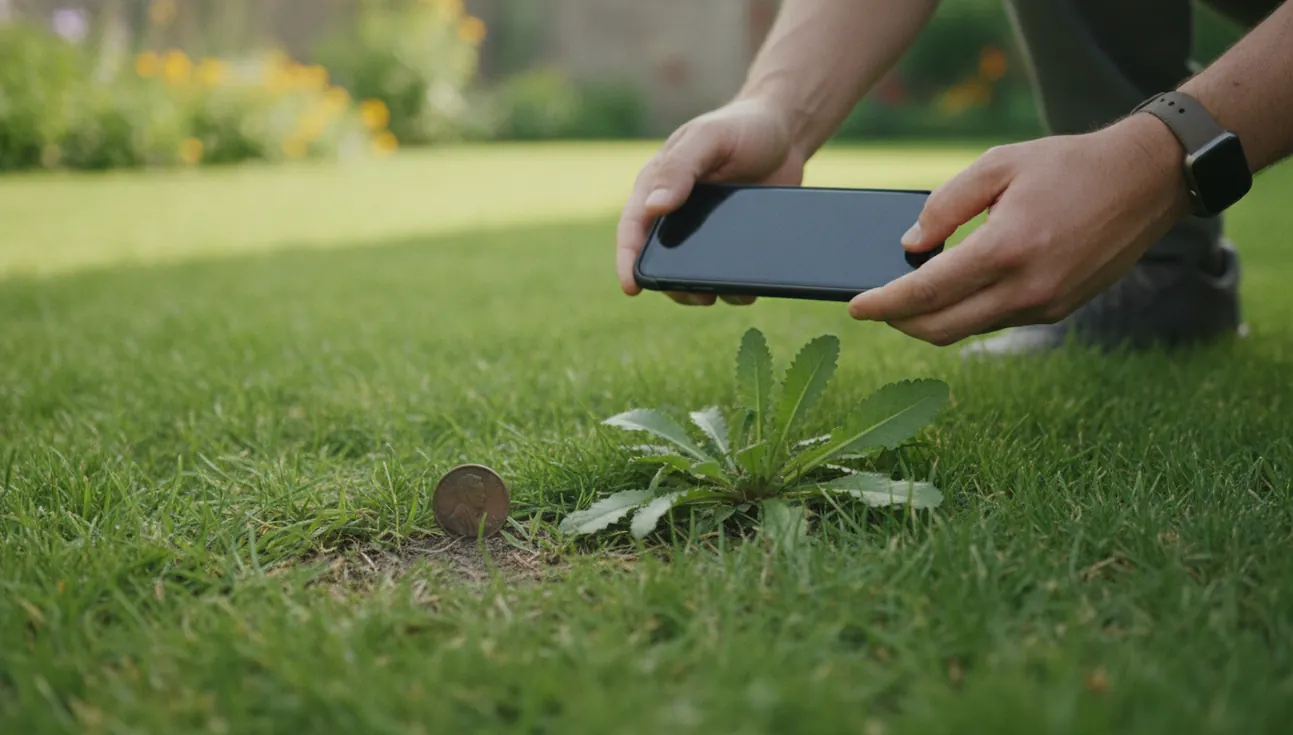
Shoot in daylight, hold the camera steady and skip filters. Then work through this order.
- Photograph the whole plant where it grows, with the soil and nearby plants in the frame.
- Take close-ups of the leaves, the stem, any flowers, and any fruit or seed head.
- Photograph the underside of a leaf and the spot where each leaf joins the stem.
- Lay a coin or ruler beside the plant for scale.
- Write down the location, date, habitat and approximate height, plus whether the plant looks hairy, milky or thorny.
Use the zoom on your camera instead of pulling leaves aside. A close photo from arm's length is enough.
Leaf, stem and growth clues that settle most weed IDs
A few features do most of the work. Check them in roughly this order.
- Leaf arrangement. Leaves sit in opposite pairs, alternate along the stem, or form a whorl. One node tells you which.
- Leaf shape and margins. Grasslike, lobed, toothed, smooth-edged, divided or compound. A lobed leaf and a compound leaf send you to different lists.
- Stem. Round, flattened, square, hollow, hairy, woody or triangular.
- Growth habit. Erect, spreading, climbing, rosette-forming or mat-forming. A flat rosette hugging the ground is a different weed from a tall upright stalk.
- Flowers. Color, petal count, flower-head structure and the month it blooms.
- Fruit and seeds. Pods, burs, capsules, winged seeds or plumes often separate two weeds with near-identical leaves.
- Roots. Taproot, fibrous roots, rhizomes, stolons or bulbs can settle stubborn cases. Do not dig up a plant you cannot yet name.
Telling grasses, sedges and broadleaf weeds apart
The University of California Integrated Pest Management program sorts weeds into broadleaf, grass and sedge, and that first split is easy to make from a photo. Broadleaf weeds usually have wider leaves with branching veins. Grasses have narrow leaves with parallel veins, and their stems are generally round or flattened. Sedges also have narrow leaves, in sets of three, and their stems are triangular in cross-section.
A lawn invader that looks like grass but has a triangular stem is a sedge, and that changes what you look up next. Photograph the stem from more than one angle so its shape shows.
Lookalike weeds and the features that separate them
These pairs trip people up. Compare the listed features, not the overall look.
| Pair | What to compare |
|---|---|
| Dandelion and similar rosette weeds | Leaf lobes, hairiness, flower stalks and seed-head structure. |
| Clover and wood sorrel | Clover usually has three rounded leaflets. Wood sorrel commonly has heart-shaped leaflets, and its flower color and leaf folding differ. |
| Crabgrass and other lawn grasses | Growth direction, leaf-hair pattern, ligule, sheath and seed-head branches. Mature plants are easier than seedlings. |
| Wild carrot and poison hemlock | Stem spotting, leaf division, flower-head structure, height and habitat. |
| Wild parsnip and similar carrot-family plants | Leaf form, stem characteristics, flowers and growth stage. |
| Poison ivy and harmless three-leaf plants | Poison ivy commonly has three leaflets, but leaf shape and margins vary. |
| Invasive plant and native lookalike | Geographic distribution and diagnostic reproductive features, checked in a state or national database. |
Two rows deserve a second look. A photo alone may not settle poison ivy, and assuming every three-leaf plant is poison ivy is as wrong as assuming it is safe. A visual match is also not proof that a plant is invasive. Confirm the range and the reproductive features first.
Confirming a weed ID with a second source
Run your photos through two independent tools instead of trusting one. Pl@ntNet is free, uses a collaborative database, and an NC State Extension guide to plant ID apps says it performs especially well for wild plants and weeds. iNaturalist is a free community science platform that gives computer suggestions and lets other users confirm or correct them. Seek by iNaturalist is built for field use and the same guide describes it as a free option. PictureThis adds details such as toxicity and natural history, though paid features and subscriptions can appear.
The widget up top is one more quick opinion, a likely name with a confidence score, and it is only a suggestion like the rest. Do not assume any app identifies every weed worldwide. A high-confidence result is still not proof.
Next, open a regional extension guide and compare the suggested species feature by feature. Check diagnostic features, then check that the range and season fit. The USDA Plants Database, listed by Cornell Cooperative Extension, helps verify names and distributions. Use a guide from your own region, because a guide from the wrong one is an easy way to go astray.
Record the result with the scientific name, common name, location, date and the features that support it. Common names shift from region to region. The scientific name keeps two people talking about the same plant.
When to send a weed photo to an expert
County Extension offices and Master Gardener volunteers can review high-quality photographs or physical samples. UF/IFAS specifically advises sending a high-quality plant photograph for identification. For a plant that affects crops, livestock or public land, or one that may be regulated, go to a herbarium or weed specialist.
Invasive and regulated species carry rules on reporting, transport, sale, disposal and removal, and those rules vary by jurisdiction. A computer-generated identification is not a regulatory determination. Collecting plants on protected land may need permission or may be prohibited.
Weeds to avoid touching, tasting or treating
No photo result is enough to justify eating, handling or treating a plant. Do not eat or use an unidentified plant medicinally, and do not taste, crush, burn or handle it. Avoid touching unknown plants, especially ones that resemble poison ivy, poison hemlock, wild parsnip or giant hogweed. Sap from wild parsnip and some similar plants can cause severe skin reactions in sunlight. Keep pets and livestock away until you know the plant is safe.
If anyone has eaten part of an unknown plant, phone poison control or a doctor straight away, and ring a vet if a pet or livestock animal did. Get medical advice for a severe skin reaction after contact. Treat any lookalike involving toxicity, eating, animal forage or herbicide as unknown until a qualified local source confirms it. Herbicide choice and rates depend on the right species and the product label, and a wrong guess can injure plants you want or break the label.
Weed identification errors to watch for
Wrong answers tend to come from the same slips.
- Photographing one leaf or one flower alone, with no underside and no stem.
- Using blurry, dark or heavily edited images.
- Ignoring plant age and season.
- Trusting a single app result, or treating the top confidence score as proof.
- Skipping the location note, or reading a guide written for another region.
- Spraying herbicide before the species is confirmed.
Remove location data before you post a weed photo
Photos can carry GPS metadata, and they can show addresses, faces, license plates or private property. Strip the metadata and crop out sensitive details before you post anywhere public. Apps also differ on how long they keep images, whether they share location and what their subscription terms say, so read those terms before you upload.
When the plant in the photo is not really a weed
Plenty of finds turn out to be a wildflower, a garden plant or a potted houseplant. The plant identifier page covers plants that are not weeds, and the houseplant identifier suits anything growing indoors. If a plant you meant to grow looks unwell, start with what is wrong with my plant. The same habits of whole-plant shots, close-ups and a recorded location help you identify many other finds from a picture.
Questions about identify weeds by picture
Can you identify weeds by picture for free?
Yes. Pl@ntNet, iNaturalist and Seek by iNaturalist are free, and county Extension offices can review a good photo. Confirm any result against a guide written for your region.
Which photos should I take to identify a weed?
Start with the whole plant in its habitat, then move to close-ups of leaves, stem, flowers and seed heads. Add a leaf underside, the leaf-stem joint and an object for scale.
How can I tell grass, sedge and broadleaf weeds apart?
Broadleaf weeds have wider leaves with branching veins. Grasses have narrow, parallel-veined leaves and round or flattened stems. Sedges have narrow leaves in sets of three and triangular stems.
Is it safe to touch a weed to identify it?
No. Avoid touching unknown plants, especially lookalikes of poison ivy, poison hemlock, wild parsnip or giant hogweed. Photograph from a distance and use your camera zoom.
Which app is best for identifying weeds?
An NC State Extension guide says Pl@ntNet performs especially well for wild plants and weeds. Use it alongside iNaturalist, then verify with a regional extension guide.
Where can I find weed pictures with names?
University extension guides are a good start. The UMass guide has over 2,200 images covering more than 300 Northeast weed species, and University of Maryland Extension has photo pages for local weeds.
Who can identify a weed I cannot name?
Contact your county Extension office or Master Gardener volunteers, who can review clear photos or samples. UF/IFAS advises sending a high-quality plant photograph.
Why does the same weed look different in different photos?
Seedlings can look substantially different from flowering or fruiting plants. Season, habitat and photo angle also change what shows, so take several photos at the stage you see.