
What a stamp identifier can and cannot read from a photo
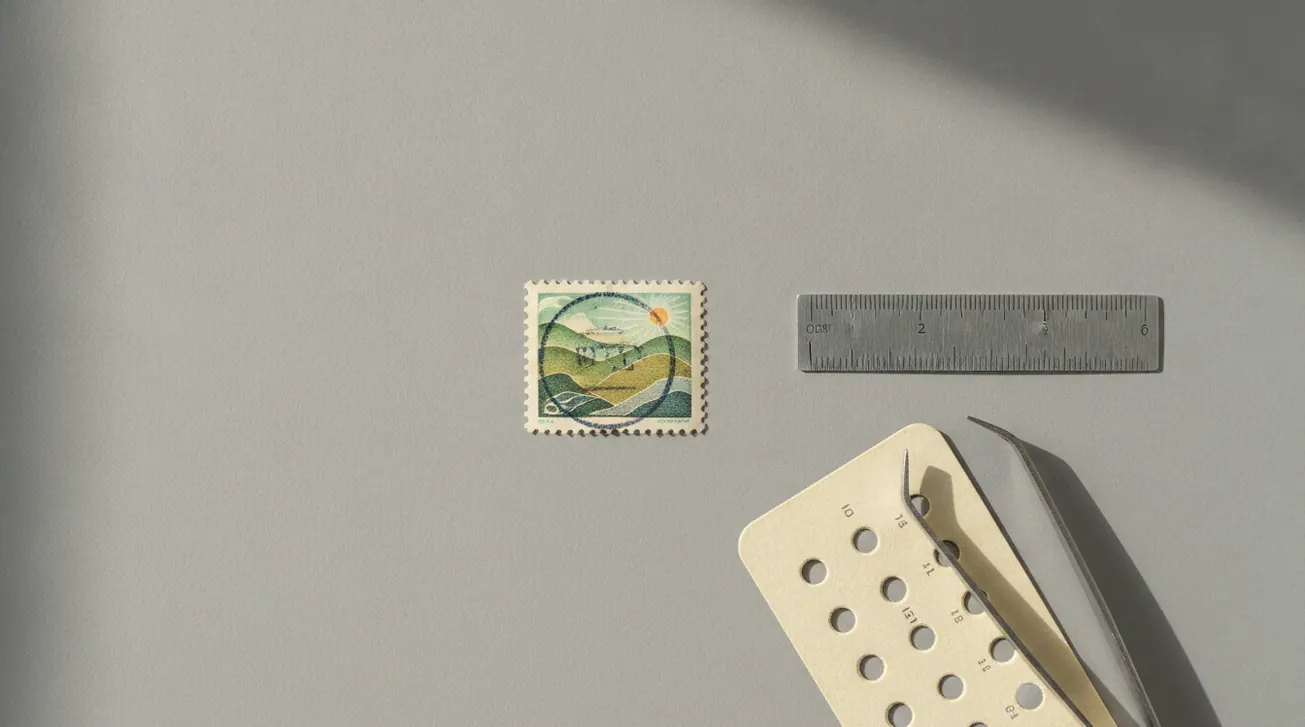
A clear picture shows the country name or emblem, the denomination, the main design, any overprint, the cancellation and whether the edges are perforated. That is enough for a probable identification. AI photo services may report country, year, denomination, catalogue number, condition, rarity, perforation, printing method, watermark and estimated value. Every one of those outputs still needs checking against a catalogue.
What a front photo cannot settle is the watermark, the paper, the gum and the exact perforation gauge. Those fine points separate printings that look the same, so take a photo result as a pointer, not as proof. Send the picture through the upload box for a first look, then take its short description and sureness note to your catalogue.
A stamp photo set that makes identification possible
Good photos save you a second attempt. Follow this order.
- Photograph one stamp at a time, straight on, in even light, with every edge visible.
- Place a ruler or scale beside it when you can.
- Photograph the back separately. Leave attached paper and gum alone.
- If the stamp sits on an envelope, shoot the whole cover too. Do not peel the stamp off just for the picture, because postal history on the cover can affect both identification and value.
Before you upload anything, crop or cover names, addresses, tracking numbers, barcodes and collection labels.
Features to write down before you search
- Country or issuing authority. Look for a country name, monarch, initials or national symbol. Some stamps carry a historical territory or symbol instead of a modern country name.
- Denomination and currency. Copy every numeral, currency symbol and surcharge. The same design can exist in several denominations.
- Design. Note the portrait, building, animal, flag, border, colors and inscription, and use a font identifier for lettering if the typeface is hard to place.
- Overprints. Record any added text, bars or changed values. Position and spelling can matter.
- Edges. Decide whether the stamp is perforated, imperforate or partly perforated.
- Cancellation. Write down readable dates, towns, bars and pen marks.
Record condition separately from identity. Centering, short perforations, tears, creases, stains, thins, hinge marks and repairs all belong in that second list.
Stamps that look the same but are not
Most wrong matches come from a handful of lookalikes. This table shows what settles each one.
| Lookalike pair | What settles it |
|---|---|
| Same design, different perforation | Measure both directions with a gauge |
| Same design, different watermark | Check the back with watermark equipment |
| Imperforate stamp versus cut-down perforated stamp | Inspect the margins and compare all four edges with a catalogue image |
| Genuine overprint versus fake overprint | Compare lettering, placement and ink with catalogue descriptions, then ask a specialist |
| Original gum versus regummed stamp | Examine the reverse in person |
Measuring perforations and checking a watermark
A perforation gauge counts holes, or teeth, per 2 cm. One consumer collecting guide gives roughly 10 to 14 as a commonly encountered range, though that is not a rule for every stamp. Some catalogued stamps have compound perforations, where the horizontal and vertical gauges differ. That is why you measure both directions. Counting by eye is a classic mistake.
A watermark is formed in the paper itself. It may show up with backlighting or a watermark tray, and an ordinary photo usually will not confirm it. Never infer a watermark because the front picture matches a catalogue image. Skip chemicals, watermark fluid and cleaning unless you know the paper and the procedure, since the wrong treatment can damage the stamp and cut its value.
Catalogues and databases for confirming a match
Once you have a candidate, compare your full feature list against a reference. The Scott Catalogue is the major reference for United States stamps. Stanley Gibbons, Michel and Yvert are established international catalogues, useful for matching stamps and comparing varieties. Colnect is an online collecting database that works well for comparison after a first identification.
Compare the catalogue descriptions and not only the pictures. Check paper, watermark, perforation, color, overprint and issue date. Photos in a database can be near matches for several different listings. Collectors who also handle metal pieces will recognize the same habit from a coin identifier workflow, where the description beats the thumbnail.
Condition, value and when to see a dealer
Catalogue value is a reference figure and not a guaranteed selling price. Real prices depend on condition, demand, authenticity and where you sell. Auction records of realized prices give a better sense of the market than a list value, and a colorful or old-looking stamp is not automatically rare.
Take the stamp to a dealer or philatelic expert if the result looks like a rarity, an unusual variety or a stamp that needs authentication, grading or valuation. Forgery, reperforation, regumming, repairs and altered cancellations can fool a photo. An AI estimate is not an appraisal or an insurance document. Stamp tongs are the better tool than fingers for handling valuable or fragile pieces. Ownership, export and import rules vary by country and item, so check them before moving anything across a border.
How stamp identification goes off course
- Matching only the picture and ignoring watermark, paper and perforation.
- Uploading only the front when the back may show gum, hinge marks or repairs.
- Soaking, trimming or regumming a stamp before an expert has seen it.
- Forgetting to note that the stamp is still on its original cover.
The same patience applies across a collection. Mixed boxes of old paper, coins and trinkets can go through an antique identifier app for a first pass, and trading cards have their own card scanner checks. For anything else you find, the identify things from a picture tool on the homepage covers the wider range.
Questions about stamp identifier
Is there a free stamp identifier?
Yes. You can compare your stamp against free online collecting databases such as Colnect after a first identification, then confirm details like perforation and watermark against a catalogue.
Is there a stamp identifier app?
AI photo apps exist and give a probable identification, sometimes with catalogue or market estimates. Take the result as a starting point, not authentication or a final appraisal.
How do I identify a stamp when I do not know the country?
Read the country name, monarch, emblem, initials or national symbol. Some stamps use a historical territory or symbol instead of a modern country name, so check catalogues for old issues.
Can a photo show a stamp's watermark?
Usually not. A watermark is formed in the paper and typically needs backlighting or a watermark tray, so an ordinary front photograph rarely confirms it reliably.
How do you measure stamp perforations?
Use a perforation gauge, which counts holes or teeth per 2 cm. Measure horizontal and vertical edges separately, since some stamps have compound perforations.
How do I find out what a stamp is worth?
Identify it first, then check catalogue listings, record its condition and compare realized auction prices. Catalogue value is a reference figure, not a guaranteed sale price.
Should I remove a stamp from its envelope to identify it?
No. Postal history and cover context can matter for identification and value, so photograph the whole cover and leave the stamp attached.
Can AI authenticate a stamp?
No. Forgery, reperforation, regumming, repairs and altered cancellations may need specialist examination, so use an independent philatelic expert for valuable or unusual stamps.