
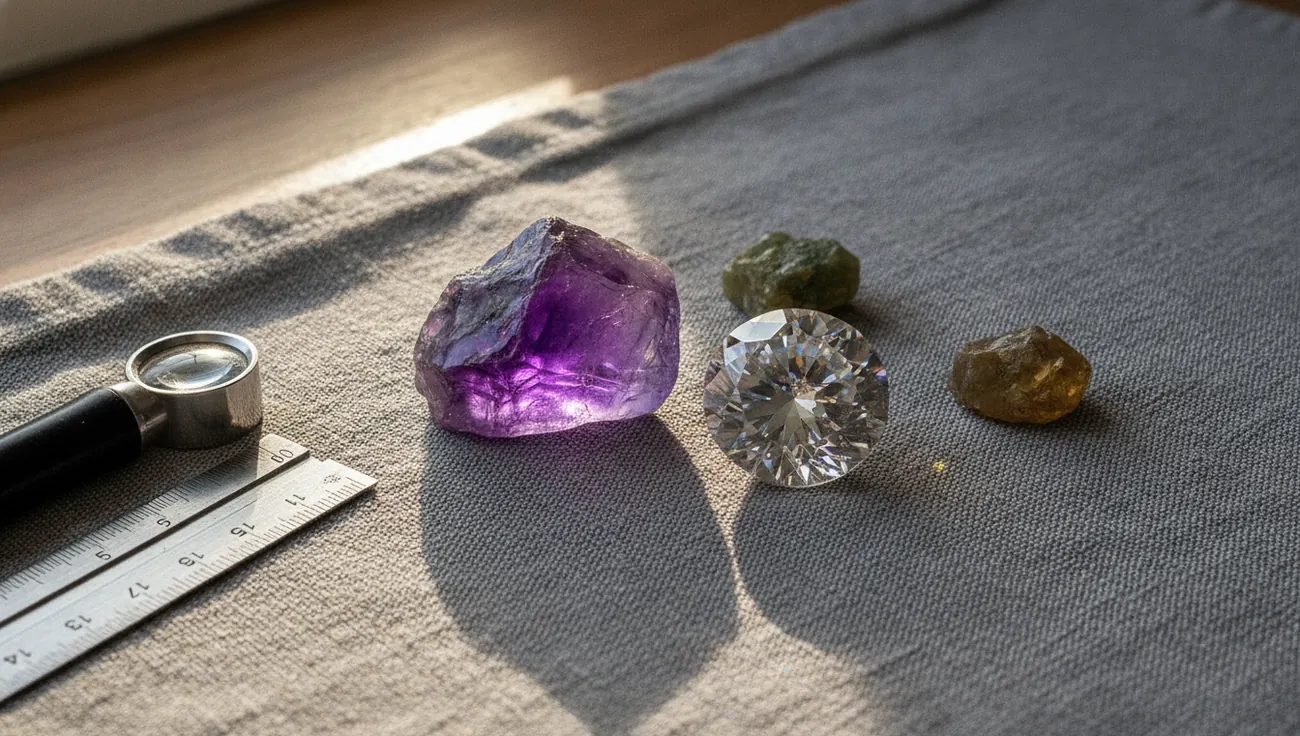
Gemstone identifier limits: how far one photo goes
A photo shows color, transparency, luster, shape and surface. That is enough to suggest candidates. It is not enough to prove one. Purple, glassy and translucent could be amethyst, purple glass or purple fluorite, and a camera does not know which.
So treat any result as a starting list. Want a quick read on the visible features? Drop your stone photo into the tool on this page, and take the likely answer and its certainty score as one clue, not a ruling. The real work is in the photos you take and the physical clues you add afterward.
Three things stay out of reach for an untested stone, whatever tool you use. The exact species may be uncertain, because lookalikes overlap. Treatment, such as heat, dye or coating, is usually invisible in an ordinary photo. And value cannot be calculated at all. That is the honest limit, and the rest of this page is about working inside it.
Details to capture before you try to name a stone
When people ask what is this stone, they usually send one blurry shot of the prettiest side. Take several, each showing something different. These are the features that settle most identifications.
- Color and zoning. Note the body color, any bands or patches, and whether the color seems to change as you turn the stone. Color alone is weak evidence, because different minerals share colors and treatments can change how a stone looks.
- Transparency. Is it transparent, translucent or opaque? Hold it against a window and photograph it with light behind it.
- Luster. Glassy, resinous, pearly, silky, metallic or dull. Luster is often easier to see in a photo than color is.
- Crystal form. Hexagonal, cubic, prismatic, tabular, fibrous, botryoidal, massive or granular. Natural faces tell you a lot.
- Breaks. Repeated flat surfaces suggest cleavage. Irregular curved breaks suggest fracture.
- Surface texture. Natural crystal faces, rounded waterworn surfaces, polish marks, pits, coatings or bubbles.
- Inclusions. Needles, veils, tiny crystals, fluid inclusions, growth bands or gas bubbles. Round gas bubbles point toward glass.
- Context. Any matrix rock attached, the locality, a mine label, a receipt, and whether it is a loose specimen or sits in a setting.
- Scale. Set a millimeter ruler or a coin beside the stone. Perspective makes stones look bigger or smaller than they are.
Lighting and angles that make stone details show
Good photos do more than any app. Follow this order and you will have what a gemologist, a mineral club or a database search will ask for.
- Photograph the stone in diffuse daylight, then again in neutral indoor light. Direct sun and warm bulbs both shift color.
- Shoot the front, back, sides, crystal faces, fractures, inclusions, the setting and any label.
- Include a ruler, and write down the dimensions and the weight.
- Record where and when you found or bought it, and keep the receipt and the seller's claims.
- Write what you see, not what you hope. Put "purple, translucent, glassy luster" in your notes, not "amethyst."
Before you upload anything online, crop out faces, addresses, receipts, serial numbers and shipping labels, and strip precise GPS data from the file. If the find came from a rare or private spot, do not post exact coordinates.
Gemstones and the lookalikes that fool people
Most wrong identifications come from a handful of familiar swaps. This table lists the usual pairs and what separates them. In nearly every row, the separating clue is something a photo cannot show.
| Looks like | Often confused with | What separates them |
|---|---|---|
| Clear quartz | Glass, cubic zirconia, synthetic quartz | Quartz commonly shows natural inclusions and lacks the perfectly uniform look of many glasses. A photo is not enough to confirm. |
| Amethyst | Purple glass, purple fluorite, synthetic corundum | Color and transparency overlap. Hardness, specific gravity, optic behavior and inclusions are needed. |
| Citrine | Heat-treated amethyst, yellow glass, synthetic material | Commercial citrine may be heat-treated amethyst, and an ordinary photo cannot show treatment. |
| Blue sapphire | Blue spinel, blue glass, tanzanite, iolite | Refractive behavior, hardness, specific gravity, inclusions and spectroscopy. |
| Ruby | Red spinel, red garnet, glass, synthetic corundum | Red is not diagnostic. Laboratory testing may be required. |
| Emerald | Green glass, green tourmaline, peridot, treated beryl | Inclusions, refractive properties, specific gravity and a treatment exam. |
| Jade | Serpentine, chalcedony, glass, other green rocks | Jade can mean jadeite or nephrite. Color alone cannot decide it, so testing is needed. |
| Turquoise | Dyed howlite or magnesite, dyed chalcedony, plastic | Matrix pattern and color are suggestive only. Dye and polymer treatments can imitate natural material. |
| Diamond | Cubic zirconia, moissanite, glass | Thermal, electrical, optical and microscopic tests. A scratch test is not a safe or reliable consumer test. |
| Opal | Glass, plastic, synthetic opal, coated material | Play-of-color pattern and structure must be examined under magnification. |
One more trap sits behind the table. A clear, polished, faceted stone is not automatically natural. Synthetic, imitation, composite, coated, dyed and heat-treated materials all exist, and a trade name on a tag is a marketing label, not a mineral species.
Why color settles so little when you ask what crystal is this
Color is the first thing everyone sees and the least reliable thing to go on. Red could be ruby, red spinel, red garnet or glass. Green could be emerald, tourmaline, peridot or a bottle fragment. Blue stretches from sapphire to spinel to tanzanite to iolite.
Better clues are the quieter ones. Look for how light moves through the stone, whether the surface is glassy or waxy, whether the edges show flat cleavage steps or curved fractures, and whether tiny crystals or growth lines sit inside. Describe those first. The color word comes last.
Raw crystal specimens versus cut stones
A crystal identifier question about a raw piece is often easier than one about a faceted stone. Natural faces, the shape of the crystal and any attached matrix rock tell a mineral person a great deal, and the locality narrows things further, whether you are sorting crystals or beach finds like those in our guide to identifying seashells. Shoot the termination, the sides and the base, and photograph the rock it grew on.
A faceted stone has lost most of that. The cutter removed the crystal form, so you rely on inclusions, luster and measured properties. If your find is really a plain rock with a pretty patch, our rock identifier guide covers texture, banding and what to photograph.
Mounted stones and what a jewelry identifier cannot see
A jewelry identifier faces a harder job than a specimen identifier. The metal setting hides the back and sides of the stone, light enters from fewer angles, and you cannot weigh or measure it. Photograph the stone from above and at a slant, the underside of the piece, any hallmarks, and the claws or bezel holding it, and if a label or stamp has unusual lettering, try our guide to identifying a typeface.
A credentialed gemologist can examine mounted jewelry and choose tests that do not damage it. Check the person's credentials and independence before you hand anything over. If the piece is old or comes with a story, our antique identifier page covers how to document the object itself, not only the stone.
Tests to skip on an unknown stone
Home testing causes more harm than a wrong guess does. Do not lick, inhale, grind, heat, burn, acid-test or powder an unknown mineral. Some contain toxic elements, and dust, fumes and chemical reactions are possible.
Scratch testing deserves its own warning. It can permanently damage a valuable specimen or a piece of jewelry, and it can still give a misleading answer. Keep unstable minerals, treated stones and jewelry away from chemicals, ultrasonic cleaners, steam, heat and sudden temperature changes unless a professional says otherwise.
Collecting rules are a separate matter. They depend on the country, state, landowner, protected area, archaeological status and mineral type, so check them for the place you found the stone, and before you export anything.
Using Mindat to narrow your candidates
Mindat is the reference most mineral people reach for. It has been online since October 2000, according to a scholarly description of the site. Its minerals page listed 6,152 IMA-approved mineral species in its October 19, 2026 update, and the site reported 1,461,113 uploaded photographs.
Those numbers matter because a big photo database lets you compare your stone with real specimens and locality shots, not only polished product images. Mindat also lets you search by hardness, specific gravity, color, streak, luster and transparency. That is a good reminder that photos work best alongside physical properties.
A sensible way to use a gemstone identifier result next to Mindat goes like this. Take the two or three candidates the photo suggests. Open each species page. Compare the crystal habit, luster and typical localities with your notes. Then use the non-destructive properties you can check safely, such as luster, transparency, cleavage and streak, to drop candidates. Avoid comparing only against glossy commercial photos, which show the best examples and hide the ordinary ones.
When to send a stone to a gemologist or laboratory
Go to a professional whenever the answer affects money, insurance, resale or legal export. A gemological laboratory can test refractive index, specific gravity, spectroscopy, microscopy and fluorescence, and it can look for treatments. It can sometimes also say something about geographic origin. Which laboratory suits you depends on the item and the country.
For a lower-stakes question, a mineral club, a university geology department, a museum or a geological survey may help, though their services, fees and availability vary. Ask first.
When you write up a result, match the wording to the evidence. "Consistent with quartz" is fair for a photo comparison. "Laboratory-confirmed quartz" is only fair after testing. If nothing supports a species, "unknown" is the correct answer, and it is better than a confident wrong one.
A photo cannot give a price for your stone
People who find a purple stone want a number, and no photo can supply one. Value depends on species, weight, color quality, clarity, treatment, origin, cut, provenance, certification and current market conditions. Most of those are invisible in a picture. Rarity, age and provenance need documents, not guesses.
The same applies to the question of how to identify valuable rocks. Valuable and ordinary specimens can look alike, so identify the stone first, test it properly, and only then ask what it is worth. If your find turns out to be a coin, a stamp or a collectible such as a trading card instead, our coin identifier guide covers a different set of clues, and our Pokemon card scanning guide helps with cards.
Common reasons a stone gets the wrong name
- Treating color as identification.
- Calling a trade name or marketing label a species.
- Assuming anything clear, polished or faceted is natural.
- Using one photo with no scale, locality or lighting information.
- Treating an app's top result as proof, especially before a purchase or an insurance claim.
- Running a hardness or acid test without thinking about damage and safety.
- Naming a precise species when the honest result is unknown.
If you have a different kind of find, the picture identifier on our homepage handles plants, bugs, birds and more from a single photo.
Questions about gemstone identifier
Can a photo identify a gemstone?
A photo can suggest candidates from color, luster and form, but it cannot confirm species, treatment or origin. Confirmation needs physical measurements or a qualified gemologist.
Is a gemstone identifier app enough to confirm what my stone is?
No. A gemstone identifier can suggest a few candidates from a photo, but it cannot confirm the species, the treatment or the value. Confirming takes measurements or a qualified gemologist.
How can I tell if a gem is real or glass?
Look for natural inclusions, since quartz often has them and many glasses look perfectly uniform. Round gas bubbles suggest glass. A gemologist or laboratory should confirm it.
What can be mistaken for a diamond?
Cubic zirconia, moissanite and glass are common lookalikes. Thermal, electrical, optical and microscopic tests tell them apart, and a scratch test is not safe or reliable.
Is it safe to scratch test a gemstone at home?
No. Scratching can permanently damage jewelry or a valuable specimen and still give a misleading result. Use photos, observation and professional testing instead.
Can I get a value for a stone from a picture?
No. Value depends on species, weight, color quality, clarity, treatment, origin, cut, provenance, certification and market conditions, which a photo cannot show.
Why is color not enough to identify a crystal?
Different minerals share colors, and treatments such as heat or dye can change appearance. Luster, transparency, inclusions, breaks and measured properties are stronger evidence.
Where can I compare my stone with real specimens?
Mindat has large photo galleries of minerals and localities, plus property searches for hardness, specific gravity, color, streak, luster and transparency.
What photos should I take of an unknown stone?
Take front, back, side, crystal face, fracture, inclusion, setting and label shots in diffuse daylight, each with a ruler. Record weight, dimensions and where you found it.