
Symptoms a photo shows, and causes it hides
Penn State Extension lists the usual signs of a struggling plant as yellow leaves, leaf spots, blotches, and roots that fall apart when you pull them. Each of those can come from disease, insects, watering, nutrition, environmental stress or root damage. That is why the question what is wrong with my plant rarely has a one-picture answer, and why some cases end up in a diagnostic laboratory.
A photo does three jobs well.
- It shows the likely species or genus, which you need before any advice about care or disease makes sense.
- It shows which part is affected, whether leaf, stem, root, flower, fruit or seed.
- It records visible symptoms and signs, such as spots, lesions, insects, webbing, mold, ooze and distorted growth.
It fails in three predictable ways. The image may lack detail. The plant may have no flowers or fruit to help with the species. Or several causes may produce the same symptom, and then the picture cannot choose between them. Treat any photo result as a lead to check, not a verdict.
The photos that make a diagnosis possible
One close-up of a brown spot is the most common upload and the least useful. Take a set instead.
- The whole plant and the area around it, in natural light.
- The upper and lower surface of several leaves.
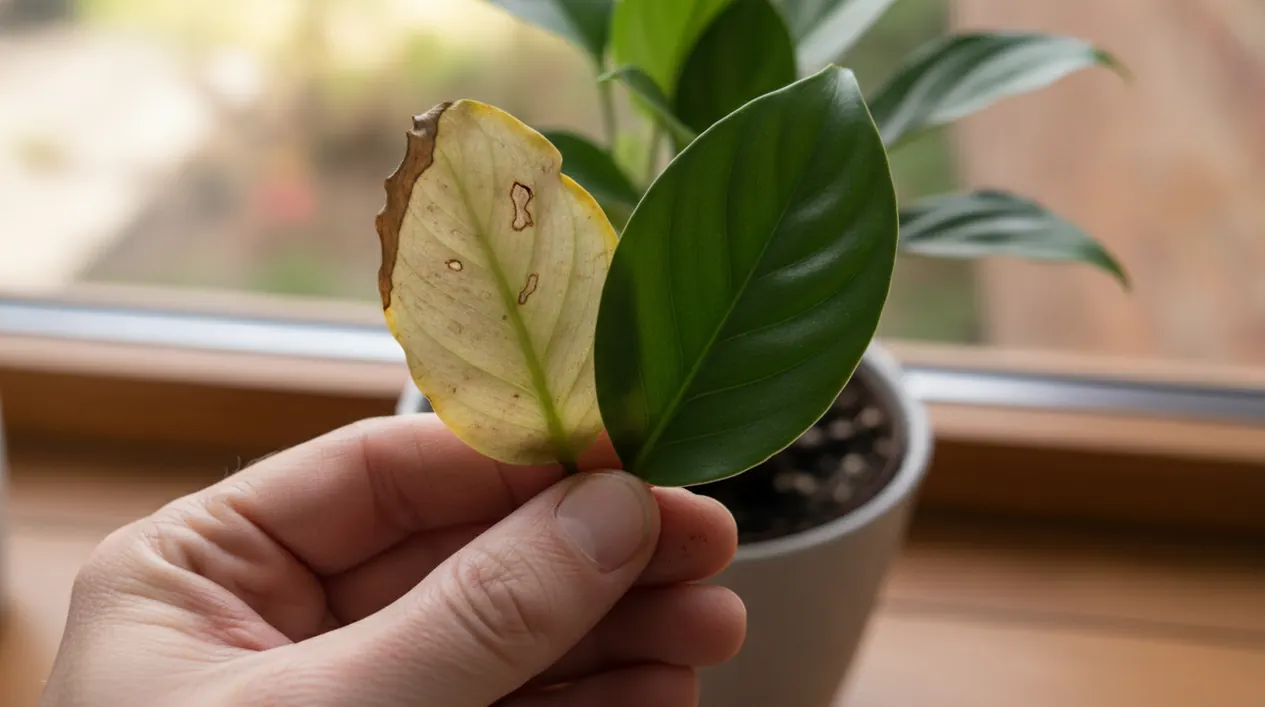
- One healthy leaf beside one damaged leaf, so the difference is obvious.
- Close-ups of spots, holes, margins, veins, lesions, webs, eggs or insects.
- Stem junctions and the soil surface. Show roots only if they are already exposed.
- Flowers, fruit, seeds, bark and the overall growth habit.
Leaf arrangement, shape, margin, veins, texture, hairs and color all help with the species, and the species narrows the list of likely problems. Roots, bracts and internal damage often do not show in a normal photograph. A picture of healthy-looking leaves does not clear the roots.
Write down what the camera cannot record. Note where the plant lives, the date, recent weather, how and when you water, any fertilizer, repotting or spraying, and whether the damage began on new growth or old. If privacy matters, crop out house numbers and faces and strip GPS data before you upload a photo anywhere.
Look-alike problems and what separates them
Most wrong guesses come from a few pairs that look the same in a picture.
| Pair that looks alike | Clues that lean one way | What decides it |
|---|---|---|
| Nutrient deficiency or disease | Both can cause yellowing or mottling. Whether older or newer leaves are affected matters. | Root condition and growing history. A single image cannot give the cause. |
| Insect damage or fungal damage | Holes, stippling, mines, chewing edges, webbing, eggs or visible insects point to pests. Lesions, mold or fruiting structures may point to infection. | A physical inspection, because the symptoms overlap. |
| Sunscald or chemical injury or disease | Sharply localized browning after sun exposure or spraying can resemble a lesion. | Your history of light changes and sprays. |
| Natural aging or illness | Uniform yellowing of older leaves may be normal senescence. | The species and its growing conditions. |
| Two similar species | Leaf shape alone can mislead with cultivars and wild plants. | Flowers, fruit, bark, habitat and growth habit. |
The pattern across the plant helps. Check whether the symptom sits on old leaves, new leaves, one branch or the entire plant. A single damaged branch points somewhere different from every leaf declining at once. Even so, no pattern settles the cause alone.
Why insect damage hides on the underside of leaves
Turn the leaves over. Holes, stippling, mines, chewing edges, webbing, eggs and live insects all support pest damage, and the lower surface is where much of it hides. If you find something small and moving, a bug identifier by photo can help you name it before you decide what to do. Notice odor too, and look for soft roots and poor drainage, which no leaf photo will show.
Run this check today, one step at a time
- Photograph the whole plant in natural light, then both sides of several leaves, then close-ups of the symptoms.
- Pin down the species. If you do not know it, start with a plant identifier by picture. For indoor plants, a houseplant identifier narrows the field faster. A plant you never planted may be a weed, and a weed identifier handles that case.
- Compare the proposed name with a trusted botanical or Extension source. Do not accept an app's top result as certain.
- Note whether the damage is on old leaves, new leaves, one branch or everywhere.
- Inspect the plant with your hands. Look for insects, eggs, webbing, odor, soft roots, drainage problems and signs of spray injury. Wear gloves when you handle sap, insects, mold or suspect soil.
- Review watering, drainage, light, temperature, fertilizer and any recent chemical exposure.
- Do not apply pesticide, fertilizer or fungicide until the likely cause and the plant's identity are reasonably established.
- If the cause is still open after all that, call your local Extension office.
Notice what the list asks of you. Most of the work is looking and recording, not buying a product.
Why spraying first makes the problem harder to read
The urge to grab a spray bottle is strong. Resist it for a few days. Penn State Extension and the broader guidance on diagnosis both point the same way, which is to find the cause before treating.
There are two practical reasons. First, a spray can itself cause damage. Sharply localized browning after spraying can resemble a disease lesion, so a treatment applied on a guess can create a new symptom on top of the old one. Second, applying several treatments at once makes the cause impossible to evaluate. If the plant improves, you will not know which step helped. If it worsens, you will not know which one hurt.
That includes kitchen remedies. Vinegar, dish soap and coffee grounds are still treatments, and they still add a variable. Yellow leaves are also not always a nutrient problem, so adding fertilizer to a plant with root trouble or a watering problem treats the wrong thing. If you must change something, change one thing, note the date and watch.
What plant apps can and cannot do for plant problems
Apps are good at one question, which is what species this is. They are not tested on the question of what is wrong with my plant. A 2026 comparison explicitly reported that its tests did not measure disease diagnosis or care advice, so no independent accuracy figure exists for the compared apps on disease.
For naming the plant, there are numbers. A 2022 University of Illinois Extension summary of leaf identification reported these results.
| App | Correct to genus | Correct to species |
|---|---|---|
| PictureThis | 97.3% | 83.9% |
| iNaturalist | 92.3% | 69.6% |
PictureThis has also claimed 99% accuracy for common species and 95% overall, according to a 2022 report. Those are company claims, not an independent validation. The same report put the PlantNet database at more than 27,000 species and iNaturalist at more than 250,000 species, which includes animals as well as plants.
North Carolina Cooperative Extension describes Seek by iNaturalist as a free option with above-average identification performance. PictureThis is a commercial app with a limited free version, plant identification, care information and pest-identification features. A reasonable method is to run the same photos through PlantNet and iNaturalist, and treat PictureThis as one more opinion, not proof. For a general tool that can identify things from a photo beyond plants, the widget on this page works as an option. The AI describes what it sees and returns a certainty rating. Its answer is a suggestion, like the apps above.
Apps analyze leaves, flowers, fruit, bark and overall growth habit. They cannot see roots, bracts or internal damage in a typical picture. When a result looks wrong, that gap is the first place to look.
When to take the plant to an Extension office or lab
Penn State Extension notes that some cases require submitting a sample to a diagnostic laboratory. A lab is the right step when symptoms are severe, spreading, ambiguous or not distinguishable visually. Your local university Extension office can help with plant disease identification and can tell you how to collect and send a sample.
Call sooner if the plant is valuable, invasive, poisonous or declining quickly. Do not move suspected invasive pests or diseased plant material across jurisdictions. The exact legal requirements depend on where you live, so ask the Extension office before you mail or carry anything.
Warning signs and who to call
A photo is never enough to eat, handle or treat anything. Do not eat an unidentified plant or plant part, according to University of Wisconsin Extension. Keep unknown plants, seeds and bulbs away from children and pets. A plant that is missing from a poisonous-plant list is not necessarily safe.
If a child or pet may have chewed or swallowed any part of a plant, contact a doctor, an emergency department, a veterinarian or a poison service immediately. Do not wait for an app result and do not assume the plant's identity from one.
Mistakes that hide the cause
- Taking an app's first suggestion as settled.
- Using one blurry photograph.
- Photographing only the damaged part and not the whole plant.
- Leaving out the lower leaf surface, flowers, fruit or habitat.
- Confusing a symptom with a diagnosis. Yellow leaves are a symptom, not an answer.
- Applying several treatments at once.
- Ignoring watering, drainage, light, temperature, fertilizer and recent chemical exposure.
- Assuming all yellow leaves mean a nutrient deficiency.
- Assuming a plant is edible or safe because an app named it.
- Skipping a local expert or lab when symptoms stay ambiguous.
Avoid most of these and you have already done better than a single blurry close-up and a guess.
Questions about what is wrong with my plant
How do you tell if your plants are dying?
Look for yellow leaves, spots, blotches, wilting, or roots that fall apart when pulled, as Penn State Extension lists. Spreading or rapid decline means contact an Extension office or lab.
Can plants recover from yellow leaves?
The cause decides that. Uniform yellowing of older leaves may be normal aging, but yellowing can also come from disease, insects, watering, nutrition or root damage, so find the cause first.
What is the number one killer of houseplants?
A photo cannot name one cause. Watering, drainage, light, temperature, fertilizer and recent chemical exposure can all damage a plant, so check each before blaming disease.
Can I spray vinegar on my plants to keep bugs away?
Hold off until you know the plant and the cause. Spraying can leave sharp brown patches that resemble disease, and several treatments at once hide what worked.
Can I spray Dawn and water on my plants?
Confirm the plant and the pest first. Pesticide should wait until the cause is established, and spray injury can look like a disease lesion.
Should I spray my sick plant right away to fix it?
No. Find the cause first, because a spray can itself cause browning that looks like disease, and several treatments at once make it impossible to tell what helped or hurt.
Can an app diagnose plant disease from a photo?
Apps identify species fairly well, but a 2026 comparison said its tests did not measure disease diagnosis. Treat results as a lead and confirm with an Extension office.
When should I send a plant sample to a lab?
Send one when symptoms are severe, spreading, ambiguous or cannot be told apart visually, as Penn State Extension advises. Your local Extension office can explain how to collect it.
Sources
- Penn State Extension: Your plants look sick, now what
- University of Illinois Extension: How accurate are photo-based plant identification apps
- The Beacon Newspapers: An app that answers what's that plant
- North Carolina Cooperative Extension: Guide to plant ID apps
- University of Wisconsin Extension: Common plants, what's poisonous and what's not
- UConn Home and Garden Education Center: Houseplants, safe and toxic varieties
- PlantLens: Best plant identification app comparison
- UWA News: Smartphone plant identification apps