
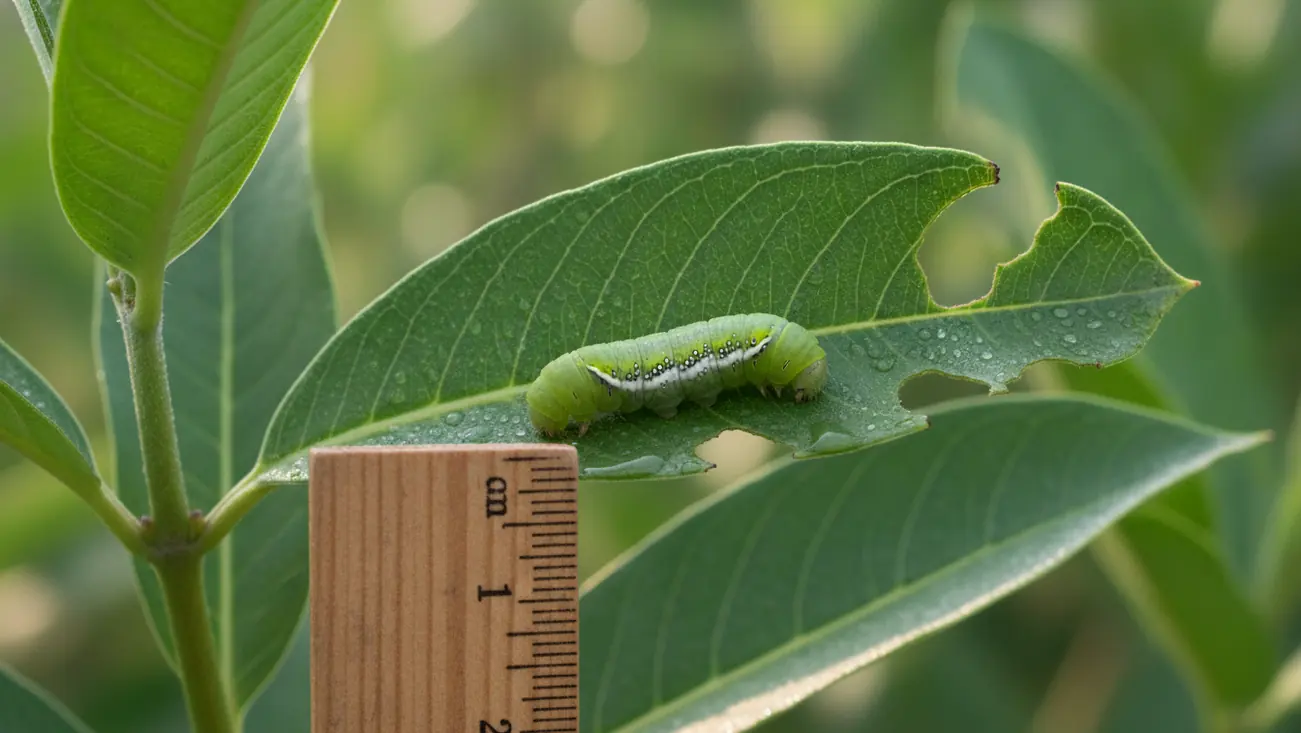
Before you identify a caterpillar, photograph these
Take the pictures first and search second. Caterpillars wander off, and the one on the leaf now may be gone when you come back.
Start with the whole animal, in focus, from the side. Then add close-ups of the head, the rear end, any hairs or spines, and the legs. Put a ruler or a coin beside it for scale, and do not touch it to line things up. Size shifts a lot between growth stages, so a length means little without the stage.
Then photograph what it is sitting on. Host plant is one of the strongest clues, and Butterflies and Moths of North America specifically recommends recording it. Shoot the whole plant, a leaf, and any chewed edges, webbing or shelter, and if the foliage looks damaged, our tool for diagnosing plant problems can help, while for an indoor plant, our houseplant, succulent and cactus identifier can name it. If you cannot name the plant, identify the plant from a picture first, because that single fact often removes half the candidates.
Details worth writing down on the spot
- Location, meaning country, state or province, and nearest town. Many species have restricted ranges.
- Date, time, and whether it was active by day or at night.
- Body shape. Smooth, flattened, slug-like, swollen or tapered. Shape stays useful when color varies within a species.
- Markings. Stripes along the body, bands across it, spots, eyespots, and whether they sit in rows or scatter.
- Hairs and spines. Sparse or dense, branched, paired, brush-like, or bunched at the front or rear.
- Head color and markings, plus any forked or horned tail.
- Behavior. Looping, dropping on a silk thread, rolling up, thrashing, or feeding in a set position.
Naming your find in a few ordered steps
- Decide whether it is really a caterpillar and not a sawfly larva or a beetle grub.
- Search a regional database using one or two obvious features, not every detail at once.
- Compare at least three candidate species by body shape, host plant, range, season and pattern.
- Submit your photos to a reputable identification community or an expert for review.
- Treat any AI suggestion as a hypothesis until your photos and the known range agree with it.
- When you report a name, record the evidence and your confidence level beside it.
Caterpillar, sawfly larva or beetle grub?
Sawfly larvae look a lot like caterpillars, but they are wasp larvae. They are not young butterflies or moths. The arrangement of legs and prolegs, the body texture, and a comparison by someone experienced help separate them. For the adult group, see our guide to bees and wasps.
Beetle larvae are not caterpillars either, and neither are spiders, which our guide to identifying common spiders covers, or ticks, which our guide to identifying ticks by photo explains. They are often pale, curved or worm-like. A clear shot of the head, the legs, the body segments and the habitat settles most cases. If the animal turns out to be neither, the bug identifier page covers the wider field.
Does a caterpillar tell you if it becomes a butterfly or a moth?
Usually not. Appearance rarely shows whether the adult will be a butterfly or a moth. Hairy does not mean moth, and smooth does not mean butterfly.
Better evidence comes from the host plant, the regional range, and photos of the mature stage. Where those still leave doubt, rearing or expert confirmation is the next step. Rearing comes with conditions, which the safety section below covers.
Why the same caterpillar can look like two different species
Caterpillars change markedly between growth stages, called instars. An early one may have different colors, markings and hair patterns from the final one, so a juvenile compared with an adult photo is a classic wrong match. Nobody can tell the instar from one photo, since it depends on the species and the individual.
Mimicry adds more confusion. Some species resemble bird droppings, twigs, snakes (see our guide to identifying snakes) or other caterpillars, and color variants within one species can make an image match misleading. Compare the plant, the locality, the season and the pattern together. Never match on a single color.
Databases, communities and experts that help
Most online caterpillar identifier tools are regional databases with filters, so pick the one that matches where you live.
| Resource | Covers | Good to know |
|---|---|---|
| CaterpillarIdentification.org | North America | Lists 181 caterpillars, a database count and not every species. Filters by color and physical features, and has a side-by-side comparison tool. |
| Caterlog | Australia | Covers more than 100 species and describes mature, fully grown individuals. It suggests starting with one or two obvious features. |
| Butterflies and Moths of North America | North America | Species accounts with range and host-plant information. A pilot image-comparison project draws on more than 1,600 photos. |
| BugGuide | North America | Listed by Butterflies and Moths of North America as a useful butterfly and moth resource. |
| iNaturalist | Worldwide | Community identification. An Owlcation field guide recommends it for submitting photos, and automated suggestions there are provisional. |
People are still the final check. University extension entomologists, museum entomology departments, natural-history societies and regional moth or butterfly groups can review photos. Send them the full set, not a single frame, with location, date and host plant.
Where an AI photo scanner fits
Need a fast guess? Add the photo to the upload box. The AI looks at your caterpillar photo and offers a likely name plus a rating of how sure it is. That is a starting point for your database search, not the end of it. A single image may not separate closely related species or life stages, and the same habit works for identifying almost anything from a picture. Any caterpillar identifier, human or AI, is only as good as the photo and the details you record with it.
Safety rules for handling and collecting caterpillars
No picture can prove a caterpillar is harmless. Do not touch hairy or spiny caterpillars. Some species can cause stinging, dermatitis, eye injury or respiratory symptoms, and you cannot see which ones from a picture. Do not trust an app to rule out toxicity either, because a false negative could harm a person or a pet.
Keep children and pets away until it is identified. If you, a child or a pet touches one and pain, a rash, eye irritation or breathing trouble follows, call poison control or a doctor, and a veterinarian for an animal.
Leave it where it is unless an expert or local authority confirms that collecting or rearing is safe and lawful. Rules depend on your location and the species. Protected species and animals in parks, reserves or on private land need permission. Skip pesticides and do not handle the host plant while you are still working out what you have, and if weeds are growing around it, our tool to identify weeds by picture can help.
Protecting your location when you share a caterpillar photo
Geotagged photos can reveal private property or vulnerable populations. Remove GPS metadata when the exact spot is not needed. Do not post exact locations of rare species or sensitive habitats unless you have to. Before you upload anywhere, check the privacy settings, since storage, location extraction and data sharing depend on that service's current policy.
How people end up with the wrong caterpillar
- Matching only the dominant color.
- Ignoring location and host plant.
- Shooting blurry, backlit, heavily cropped or color-filtered photos.
- Leaving out a scale reference.
- Assuming every striped or hairy caterpillar is the same species.
- Rearing one without knowing its food plant, the safety and disease risks, or its legal status.
Questions about caterpillar identifier
How do you identify a caterpillar from a photo?
Photograph the whole animal from the side, add close-ups of the head, rear and hairs, note the host plant and location, then compare candidates in a regional database.
Can you tell if a caterpillar will become a butterfly or a moth?
Usually not from appearance alone. Host plant, regional range, photos of the mature stage, and rearing or expert confirmation give better answers.
Are hairy caterpillars dangerous to touch?
Some can cause stinging, dermatitis, eye injury or respiratory symptoms, and a photo cannot show which ones. Do not touch hairy or spiny caterpillars.
How do I tell a caterpillar from a sawfly larva?
Sawfly larvae are wasp larvae, not butterfly or moth larvae. Leg and proleg arrangement, body texture and expert comparison help separate them.
Why does my caterpillar not match any photos online?
Caterpillars change between growth stages, and some mimic bird droppings, twigs or other caterpillars. Compare host plant, locality, season and pattern together instead of color.
Which database is best for caterpillars in North America?
CaterpillarIdentification.org lists 181 North American caterpillars with filters, and Butterflies and Moths of North America adds species accounts with range and host-plant information.
Is there a caterpillar identifier for Australia?
Caterlog covers more than 100 Australian species and describes mature, fully grown caterpillars. It suggests starting with one or two obvious features.
Should I remove location data before sharing a caterpillar photo?
Yes, when the exact location is not needed. GPS metadata can reveal private property or vulnerable populations, so strip it and avoid posting exact spots for rare species.
Can an AI app confirm a caterpillar species?
Treat an AI result as a hypothesis until your photos and the known distribution agree. A single image may not separate closely related species.
Sources
- CaterpillarIdentification.org caterpillar database
- CaterpillarIdentification.org side-by-side comparison
- CaterpillarIdentification.org identifier
- Caterlog
- Caterlog identification tool
- Butterflies and Moths of North America identification tools
- Owlcation field guide to North American caterpillar identification