
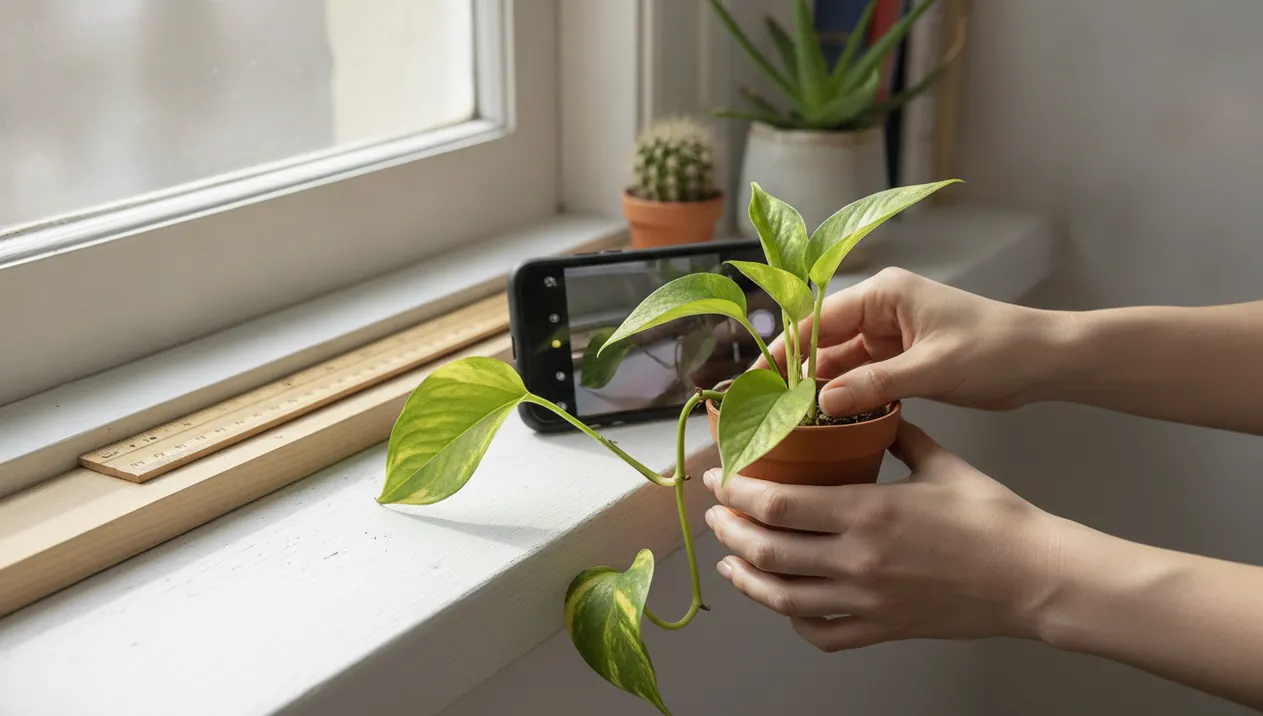
The photos a houseplant identifier needs
An app can only judge what you show it. One blurry picture of the whole pot is the most common reason for a wrong name. Take these shots instead.
- Photograph the entire plant in bright, indirect light.
- Take separate close-ups of a mature leaf, the leaf underside, the stem, a node, and any flower, fruit, spine or areole.
- Put a ruler or a familiar object in the frame for scale.
- Shoot before you pull off leaves or damage anything.
- Run the images through at least two independent tools, preferably Pl@ntNet plus iNaturalist or Google Lens.
Pl@ntNet lets you label each image as leaf, flower, fruit, bark or whole-plant habit, because each structure gives different evidence. Use that. A flower photo and a leaf photo of the same plant can point to different candidates, and the overlap is usually your answer.
Context helps too. The pot, the room, the size and where the plant came from all narrow the list, even when the app cannot see them.
Leaf and stem details that pin down a houseplant
When two apps disagree, stop looking at the overall look and check the parts. These are the details botanists lean on.
- Habit. Upright, climbing, trailing, rosette-forming, clumping or tree-like. A trailing vine and a rosette are rarely the same genus.
- Leaf arrangement. Opposite, alternate, whorled or growing from a basal rosette.
- Leaf shape and edge. Oval, lance-shaped, heart-shaped, needle-like, lobed, toothed or smooth.
- Texture. Glossy, waxy, hairy, leathery, thin or water-filled.
- Veins. Parallel lines, a net pattern, a strong midrib or a painted pattern.
- Stem. Woody or soft, jointed or not, with nodes, aerial roots, thorns or milky sap.
- Flowers and fruit. Color, petal count, symmetry and the shape of the flower cluster.
Scale matters more than people expect. A six-inch seedling and a six-foot specimen of the same species can look like different plants, so say how big yours is and how old you think it is.
Cactus or other succulent? How to tell
Plenty of people searching for a succulent or cactus identifier start with the wrong assumption: spines do not make a cactus. True cacti have areoles, the small cushion-like points where spines, hairs or new growth come out. Many non-cactus succulents have spines but no areoles. Photograph one spine up close and look at what it grows from.
Succulent features worth capturing are water-filled leaves or stems, how the leaves are arranged, ribs, offsets (the baby plants at the base) and any spines. The pairs below get mixed up constantly.
| Often confused | What to look at |
|---|---|
| Aloe and agave | Aloe leaves are usually softer and often have teeth along the edge. Agave leaves are generally stiffer, more fibrous and commonly end in a pronounced terminal spine. |
| Haworthia and aloe | Haworthia is usually smaller and may show translucent window markings or raised white bands. Aloe commonly grows longer, broader leaves. |
| Cactus and spiny succulent | Look for areoles. No areoles means it is not a true cactus. |
Wear gloves when you handle an unknown succulent or cactus. You may also meet irritating sap, and you will not know which plant has it until you have the name.
Houseplant look-alikes that fool apps
Some pairs defeat a single photo, and a good houseplant identifier will say so with a lower confidence level. Know the usual traps.
Pothos and heartleaf philodendron. Pothos often has thicker, waxier leaves and aerial-root structures. Heartleaf philodendron commonly has a more pronounced heart shape and a different petiole attachment, which is where the leaf stalk meets the blade. One photo may not be enough, so shoot the leaf base and the stem node.
Young monstera. A juvenile Monstera deliciosa may have no splits or holes yet. No fenestration does not rule the species out. If your plant is small and climbing, do not let an app talk you out of monstera on that basis alone.
Dracaena and cordyline. Both can have strap-like leaves. Telling them apart may take the flower, fruit, stem or leaf base, none of which is visible in a typical desk photo.
Species and cultivar. Many ornamental cultivars differ mainly in color, variegation or growth form. Automated tools often return the species rather than the exact cultivar, and Pl@ntNet is reported to be weaker on cultivars. Treat a species name as the floor, not the full label on the plant tag.
Free and paid plant ID tools compared
No single houseplant identifier wins every case, which is why the method above asks for two. Here is how the documented options differ.
| Tool | Cost and access | Best use |
|---|---|---|
| Pl@ntNet | Free, web and mobile | Plant-focused identification with labeled image types |
| iNaturalist | Free community platform | Unusual plants, with people discussing and correcting IDs, though slower than instant apps |
| Seek by iNaturalist | Free, camera-based | Quick family-friendly checks, with anonymous use described in comparisons |
| Google Lens | Free visual search | Fast, visually related results rather than a specialist botanical determination |
| PictureThis | Free download, paid features | Identification plus care information, disease diagnosis and toxicity warnings |
| PlantIn | App with paid features | Care plans, reminders, light measurement and Ask the Botanist consultations |
| Blossom | App | Identification from one or more photos, reminders and saved plant collections |
| Flora Incognita | Free, research-oriented | Wild plants and trees more than indoor plants |
Be careful with numbers in app marketing. One November 2026 comparison from GardensGo lists PictureThis U.S. Pro prices of $3.99, $7.99 and $39.99, plus a $49.99 family plan. Prices change by date, country and promotion, so read the checkout screen. An app comparison says PlantSnap covers more than 600,000 species, and another reports a claim of 98% accuracy across 400,000 species for PictureThis. Those are vendor or comparison claims, not an independent accuracy rate for your pothos.
The same goes for Flora Incognita, where a comparison reports a 98.8% peer-reviewed accuracy figure. Check the test conditions and scope before applying it to a plant on your windowsill, since the app is most associated with wild plants. If you want a different kind of tool for a broader set of plants, the general plant identifier by picture covers garden and wild plants as well.
Yellow leaves and spots are a different question
Naming a plant and diagnosing it are separate jobs. Yellow leaves, spots and curling can come from disease, pests, watering, light or plain aging, and an image identifier cannot reliably pin down the cause from one photograph. If the plant looks sick, see our page on a plant disease identifier for sick leaves. If you see tiny moving specks or webbing, a bug identifier for pests is the better next stop.
Do the ID first. Care advice written for the wrong plant can do real harm, such as soaking a succulent that wants to dry out.
Safety, pets and privacy when you identify a plant
Do not eat a plant, or use it medicinally, because an app named it. Some apps show toxicity warnings, but those are not an authoritative source. Confirm toxicity with a reliable veterinary, poison-control or botanical source before pets or children can touch or chew it, and keep the plant out of reach until you have.
Taking wild plants can be against the law, most of all for rare, protected or endangered species, and the rules change with location and landowner. If you found something growing outside, the weed identifier for wild plants is a better fit. Do not post the exact location of a rare wild plant.
Check your photos before you upload them. They can show faces, addresses, interiors and geolocation metadata. Also read the billing period, renewal terms and cancellation rules before you start any free trial.
Why the plant name comes back wrong
- Using one blurry whole-plant photo.
- Photographing only the top of a leaf and ignoring the underside, stem, flower or spine.
- Trusting the first result as certain.
- Mixing up a common name with a scientific name.
- Treating a species result as an exact cultivar.
- Assuming every spiny succulent is a cactus.
- Mistaking pest damage, sunburn, overwatering or nutrient stress for a trait of the species.
- Ignoring that the plant is juvenile and will look different when mature.
- Following a care recommendation before the ID is confirmed.
- Believing a claimed accuracy figure without checking how it was tested.
What to record once you have a name
Check the candidate against the plant's origin, growth habit and mature size. If the apps still disagree, post a clearly documented observation on iNaturalist or ask an expert. A botanical garden, herbarium or university extension service may help, and a licensed horticulturist can inspect the physical traits in person.
When you settle on an answer, write down the accepted scientific name, the common names, any cultivar uncertainty and keep the original photos. That record saves you from starting over when the plant flowers or fruits. And if the thing in your photo turns out not to be a plant at all, you can identify almost anything from a picture without switching sites.
Questions about houseplant identifier
How do I find out what kind of houseplant I have?
Start with the whole plant, then close-ups of a leaf, its underside, the stem and any flower. Run them through two tools, such as Pl@ntNet and iNaturalist, and compare the candidates.
Is there a totally free houseplant identifier?
Yes. Pl@ntNet is free on web and mobile, Seek by iNaturalist is a free camera-based option, and Google Lens is a free visual search.
Can Google identify a plant for me?
Google Lens can, quickly and for free. It returns visually related results rather than a specialist botanical determination, so confirm the name against leaf, stem and flower features.
Why should I use more than one houseplant identifier?
No single houseplant identifier wins every case, so run your photos through at least two independent tools, such as Pl@ntNet plus iNaturalist or Google Lens, and treat the first result as a candidate.
How can I tell a cactus from another succulent?
Look for areoles, the small points where spines, hairs or new growth emerge. True cacti have them, while many spiny succulents do not.
Why does the app say my young monstera is something else?
Juvenile Monstera deliciosa plants may lack the splits and holes of mature leaves. Missing fenestration does not exclude the species, so compare growth habit and leaf shape too.
Are plant identifier apps accurate for houseplants?
Accuracy varies by plant and photo. Figures like 98% for PictureThis are vendor or comparison claims, so verify any result with a second tool.
Can I trust an app to tell me if a plant is toxic?
No. Some apps show toxicity warnings, but confirm with a reliable veterinary, poison-control or botanical source before pets or children can reach the plant.