
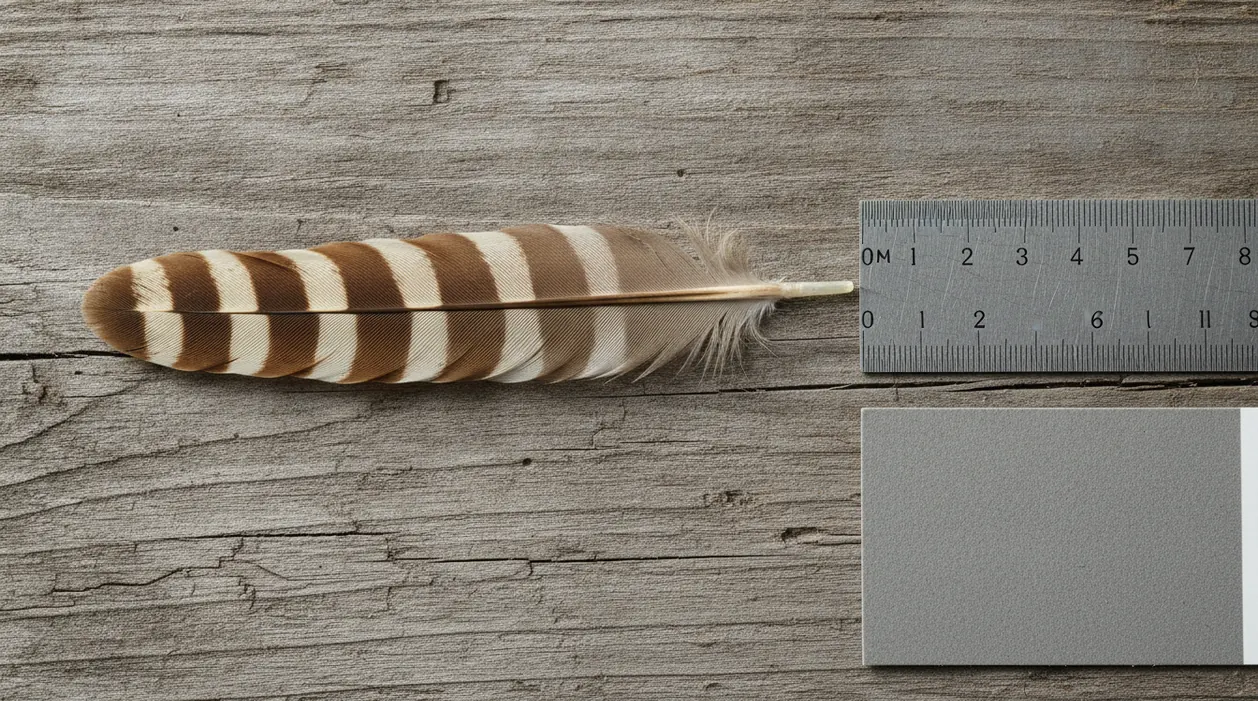
Feather identifier limits: what to expect from a photo
Most feather ID ends in "probably" or "likely," and that is an honest result. The Feather Atlas covers the large wing and tail flight feathers of about half of North American breeding-bird species, according to its own FAQ. Small body feathers are generally outside its scope. So a big barred tail feather has a decent chance of a match. A tiny speckled contour feather from a backyard may have no entry at all.
Even when you cannot tell what type of feather you have, take the photo anyway. Send the picture through the page widget and the AI suggests a feather type along with its certainty. Then compare that suggestion with a reference.
Recording a feather with photos and notes
Good notes matter more than a sharp photo. Work through this order.
- Check local and national rules before you pick it up. Photograph it where it lies, with the habitat around it.
- Lay it flat beside a metric ruler. Shoot the top and the underside in daylight, without flash.
- Add a neutral gray object for color reference if you have one.
- Write down country, state or province, exact spot, date and habitat. Note if the feather was wet, frayed or sun-bleached.
- Measure total length in millimeters, from the tip to the base of the calamus, and note the widest point.
- Decide if it is probably a primary, secondary, tail, down or contour feather, or mark it unknown.
Location is not a footnote. A candidate species that does not occur where you found the feather is out, however good the pattern looks.
Features that settle a feather ID
- Length. Millimeters beat "medium" or "large."
- Shape and asymmetry. Primary wing feathers usually have a narrow outer vane and a broad inner vane. Tail feathers are often closer to symmetrical.
- Pattern. Record bars, spots, stripes, eye-spots, edging, and whether markings cross both vanes.
- Color. Check both sides. Flash and wetness shift how color looks.
- Shaft. Note its color, thickness, stiffness, and whether the base is pale or dark.
- Vane texture. Soft, fuzzy edges can point to an owl-type feather. Stiff, smooth vanes are typical of many flight feathers.
- Wear. Frayed tips, missing barbs, a broken shaft or bleaching can make a normal feather look odd.
Owl or hawk, primary or tail: common mix-ups
Owl feathers often have soft, fringed edges and muted barring. Hawk and eagle flight feathers are generally stiffer and smoother. Treat that as a hint. It does not close the case, and a soft edge on an owl feather is easy to mistake for damage or mold.
Primary versus tail is the next trap. Primaries are commonly more asymmetrical and pointed, tail feathers more symmetrical, though species vary. Age matters too. Young birds can have different barring, edging and color than adults, and a weathered feather loses pattern contrast.
Black-and-white feathers fool people constantly. Broad color labels fail here. Size, exact bar spacing, shaft color and vane shape do the work.
Using the Feather Atlas and Merlin together
The Feather Atlas is the strongest free reference for North American flight feathers. You can browse by taxonomic group, or use its Identify My Feather filter for pattern, color and size. Compare your top three candidates against your measurements, markings, feather position and range.
Merlin Bird ID is a free app that suggests birds from a photo, with range maps, expert tips and community photos. It identifies the bird, not the loose feather. Use it to see which birds occur near your find, then go back to the atlas. eBird data behind Merlin helps with the same range check.
If two or more candidates remain, ask a regional ornithologist, a museum, a university lab or a state wildlife agency. For a question about provenance or legal status, specimen comparison is the reliable route. A photograph is not equal to holding the feather under a scope. If you want to put a name to the bird itself instead, our bird identifier page covers that, and the bird egg identifier guide covers what you might find in a nest.
Feathers are one of several signs a wild animal leaves behind, and even rocks and minerals you find outdoors can be checked with our gemstone and crystal identification guide. Prints in mud or snow have their own method, covered in our guide to identifying animal tracks. For anything you can photograph and are curious about, the picture identifier on our homepage is a place to start, and shells washed up on a beach have their own guide to identifying seashells.
Is it legal to keep a feather you find?
In the United States, often no. The Migratory Bird Treaty Act generally prohibits possessing feathers and other parts of native migratory birds without authorization. The U.S. Fish and Wildlife Service says this includes feathers that were molted or found after a road or window death. Its guidance for personal use says the same, and the rules cover feathers, whole or partial remains, nests and eggs.
Eagles get extra protection. Bald and Golden Eagle feathers fall under the Bald and Golden Eagle Protection Act, which generally prohibits possession, use and sale, with limited legal exceptions. Do not possess, sell, transport or mail them without one.
Scientific or educational use may need federal and state authorization. Feathers from non-North-American birds are outside the MBTA, but the Endangered Species Act and CITES may apply. Parrot, macaw and pheasant feathers may be legally held when they come from captive-raised birds, but a seller has to be able to document that origin. Outside the United States, rules depend on the country, so check with the local wildlife agency.
Selling is the riskiest move. Do not buy or sell a feather unless its legal origin and any permits are documented.
Feather IDs that land on the wrong species
- Going by color alone.
- Leaving out the ruler.
- Photographing only one side.
- Using flash, tinted indoor light or a cluttered background.
- Ignoring feather position and asymmetry.
- Reading a worn or damaged feather as its original pattern.
- Assuming the biggest bird nearby dropped it.
- Searching only common species and skipping range.
- Treating an app or AI suggestion, including a feather identifier result, as confirmation.
- Expecting the atlas to hold every feather type.
- Collecting first and checking wildlife law afterward.
Write your result as "likely," "probable" or "unknown" until a qualified authority confirms it. Then leave the feather, or dispose of it legally, following local wildlife guidance.
Handling dead birds and sharing photos safely
Do not handle a dead bird more than needed. If a wildlife authority tells you to, wear gloves, keep your hands away from your face and wash afterward. Report a dead or injured bird to your state or provincial wildlife agency or a licensed rehabilitator. Leave nests, eggs and live birds alone.
Before you post a photo, strip the metadata and exact coordinates. Do not publish a precise location if it could expose a sensitive nest, an endangered species or a culturally protected site.
Questions about feather identifier
How can I identify a feather from a photo?
Photograph the whole feather beside a ruler, top and underside, then compare shape, pattern, color and shaft with the Feather Atlas. Treat the result as likely, not certain.
Is there a feather identifier app?
Merlin Bird ID identifies the bird in a photo, not a loose feather. For feathers themselves, the Feather Atlas lets you filter by pattern, color and size.
Does the Feather Atlas cover every feather?
No. It covers large wing and tail flight feathers of about half of North American breeding-bird species, and small body feathers are generally outside its scope.
Is it legal to keep a feather I find?
In the United States, usually not for native migratory birds. Federal guidance says the ban covers molted feathers and feathers found after a road or window death.
How can I tell an owl feather from a hawk feather?
Owl feathers often have soft, fringed edges and muted barring, while hawk flight feathers are stiffer and smoother. That is a hint, not proof.
Can I identify a bird from a small body feather?
Often not. The Feather Atlas mainly illustrates large wing and tail feathers, so a small patterned body feather may have no matching entry.
Are eagle feathers protected?
Yes. Bald and Golden Eagle feathers are protected under the Bald and Golden Eagle Protection Act, and possession, use and sale are generally prohibited, with limited legal exceptions.
Can I sell a feather I found?
Not without documented legal origin. For many native North American birds, possession and commercial activity are prohibited without authorization.