
Bird egg photos: what they settle and what they leave open
An egg is a small, simple object with a lot of overlap between species. Blue-green shows up on several birds. Plain white shows up on many more. A photo of the egg by itself usually gives you a shortlist, and a shortlist is an honest result.
Context does the real work. The nest, the place, the date and above all the parent bird tell you more than the shell does. Any bird egg identifier, human or software, is working from thin evidence when the picture shows only an egg on a lawn or in a hand.
Features to read on an egg, from nest to shell
Start with the surroundings, then move to the shell itself. This is what to note.
| Feature | What to record |
|---|---|
| Adult bird | Usually more diagnostic than egg color. Note it from a distance. |
| Nest structure | Cup, cavity, platform, scrape, hanging nest, mud structure or ground nest. |
| Nest location | Tree height, cavity, building, cliff, shore, grassland or water edge. |
| Geography and date | Ranges and breeding seasons vary by location and year. |
| Shape | Round, oval, elliptical, or pointed at one end. |
| Color | White, cream, blue, green, brown or gray. |
| Markings | Spots, blotches, streaks, rings, speckles or none, and whether they gather at one end, spread evenly or form a ring. |
| Surface | Glossy, matte, smooth, dirty, cracked or damaged. |
| Size | Length and maximum width, measured with a ruler. |
| Number of eggs | Clutch size narrows the options but rarely names a species. |
Treat color with suspicion. Lighting and camera white balance change how a blue or cream egg looks, and color and pattern vary within a single species. Size helps only when you measure it. A nearby object is not a reliable scale, and a tilted photo distorts perspective enough to ruin any estimate.
Getting nest and egg photos without disturbing the birds
- Do not touch or move the egg, even to get a better angle.
- Shoot from several angles in neutral daylight so the color stays closer to true.
- Step back and include the whole nest and the habitat around it.
- Photograph any adult bird from a distance. Do not approach it or flush it off the nest.
- Write down the exact location, date, habitat, nest height, nest type and number of eggs.
- Add a ruler only if you can do it without disturbing the nest. Otherwise use a fixed object nearby for rough scale.
- Compare what you have with a regional field guide or an ornithology database, checking range and breeding season.
- If the evidence does not separate two or three species, call it unknown and stop there.
With the photos in hand, send the clearest one to the scanner. Check the suggested species against your local range and the time of year, especially when the picture shows only the egg.
Blue, white and speckled eggs that get mistaken for each other
Three confusions come up again and again.
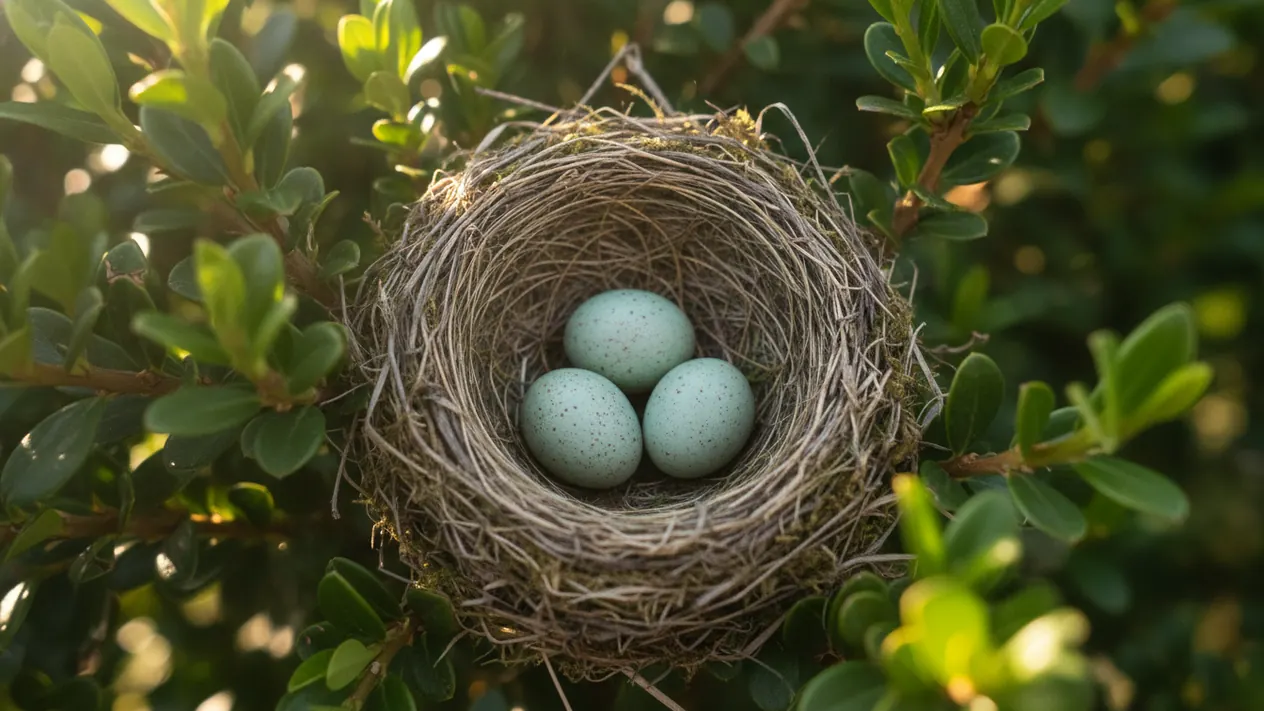
A blue-green egg is not automatically an American Robin. Several species lay in that color range, so you need the nest type, your location, the egg dimensions and the parent bird before the name holds up.
Pale eggs with dark speckles in a small cavity can point to a House Sparrow, but similar small cavity nesters lay eggs that look alike. The nest site and the adult do more for you than the speckling.
Two plain white eggs are not unique to the Mourning Dove. Nest construction and a look at the adult are essential there too. If you can get a clear picture of the parent, our bird identifier page covers how to photograph it for a better answer.
Things that look like bird eggs but are not
Artificial eggs, ceramic decorations, reptile eggs and old shells all get mistaken for intact bird eggs, and none of them make good references. An eggshell fragment is not an intact egg either. A modern bird egg generally has a thin shell and sits in a nest or scrape, unlike the thick, ridged shells you might find on a beach, which our guide to identifying common seashells can help sort out.
Claimed dinosaur eggs, fossils and collectible eggs are a different matter. They need provenance and specialist examination, and a photo cannot verify age, species or market value. For a mineral or fossil-like object, the rock identifier guide is a better start. For an old decorative piece, try the antique identifier page.
Can you pick up, keep or sell a wild bird egg
In the United States, probably not. The Migratory Bird Treaty Act, enacted in 1918, protects covered migratory birds, their nests and their eggs unless an applicable authorization or permit exists, according to the U.S. Fish and Wildlife Service. The Act's listed prohibitions include possession, transport, purchase, sale, barter, import, export and taking.
Two points from the Service's nest guidance matter most to finders. Keeping a nest found on the ground, or one removed from a tree, generally requires a federal permit. Destroying a nest that holds eggs or chicks, or one with dependent young, is prohibited. So an egg's price is beside the point for wild eggs, since sale or possession may be illegal in the first place.
State, provincial or local rules can be stricter than federal law, so check with your regional wildlife agency. An egg alone on the ground is not always abandoned, and putting it back or moving it without guidance can do harm. If the egg is on a road, inside a building or in immediate danger, call a wildlife authority or a licensed rehabilitator instead of stepping in yourself.
Who can confirm your egg identification
When your shortlist has more than one name, ask someone who can see the full picture.
- Local bird clubs and ornithologists can identify the parent bird and read the habitat.
- Museum or university ornithology departments can compare measurements, nest types, ranges and authenticated specimens.
- Licensed wildlife rehabilitators can advise when an egg is injured, displaced or tied to an active nest.
- Regional wildlife agencies can explain the local rules.
Feathers near the nest can add a clue, and the feather identifier guide shows how to photograph them, while prints or droppings nearby can be checked with our animal track and scat identifier. Field guides and bird databases let you compare range, breeding dates, nest architecture, clutch size, egg color and measurements side by side.
Mistakes that produce a wrong egg ID
Most wrong answers come from the same habits. People name an egg from color alone, or treat a blue, white or speckled egg as species-specific. They skip range and breeding season. They forget to photograph the nest and the adult. They trust a camera's color balance as true color, or guess at size with no scale.
Trusting the single top result from any bird egg identifier app counts as a mistake too, since an egg-only answer is unverified until the adult or the nest backs it up.
Posting is its own risk. Do not publish exact nest coordinates for rare or vulnerable species. Crop out faces, house numbers, license plates and private-property details before you share a photo. Found something else in the yard? The homepage photo identifier handles other objects and creatures.
Questions about bird egg identifier
Can you identify a bird egg from a picture?
Only partly. An egg photo usually yields a shortlist. Adding the nest, location, date and adult bird is what turns a shortlist into a confident identification.
How do you identify a bird egg by color and size?
Note shape, color, markings and distribution, then measure length and maximum width with a ruler. Color overlaps among species, so confirm with nest type, range and the parent bird.
Should you touch or move a bird egg you find?
No. Leave it where it is, photograph it from several angles, and stay back so adults are not flushed or the eggs exposed to predators.
Is it illegal to keep a wild bird egg or nest?
In the United States, usually yes. The Migratory Bird Treaty Act protects covered migratory birds, nests and eggs, and keeping them generally requires a permit from the U.S. Fish and Wildlife Service.
Is an egg on the ground abandoned?
Not necessarily. Do not assume it is abandoned, and do not return or move it without guidance. Contact a wildlife agency or licensed rehabilitator if it is in danger.
Are all blue bird eggs American Robin eggs?
No. Blue-green eggs overlap among several species. You need the nest, your location, the egg dimensions and the parent bird to narrow it down.
Who can confirm what species laid an egg?
A local ornithologist, bird club, museum or university ornithology department, or a licensed wildlife rehabilitator can confirm it, usually by identifying the parent bird and nest.
How can I tell a bird egg from a reptile egg?
A modern bird egg generally has a thin shell and sits in a nest or scrape. Artificial, ceramic and reptile eggs lack that context and should not be used as references.