
What a spider identifier can tell you from one photo
A photo gets you to a group far more often than to a species. The Burke Museum's educational summary counts about 100 spider families worldwide and roughly 30 in a given area, so naming the family is a realistic goal. Naming the species is harder. The museum says reliable identification may require a specialist looking through a microscope, because the diagnostic features include eye arrangement, specialized hairs, spines, claws, spinnerets and reproductive structures. Most of those never show up in a phone picture.
That is no reason to skip the photo. A sharp, well-chosen one rules out a lot, and it gives an expert something to work with. For a first look, drop it in the upload box. The AI describes the spider in your photo and gives a certainty rating, but treat it only as a hypothesis.
Treat any result, from any tool, as a hypothesis until an expert or several qualified observers confirm it. One matching picture on the internet is not proof either. The Burke Museum's spider myth pages warn against that habit, because a spider that looks just like a photo can still be a different species.
Spider features that matter more than color
Color is the first thing everyone notices and the least dependable clue. The Burke Museum notes that color and pattern vary within a species and overlap between species. Markings on the abdomen or the front of the body are useful as supporting evidence only. Lead with structure.
Eye count and eye arrangement
Most spiders have eight eyes. Recluse spiders have six, arranged in three pairs. The layout also separates look-alikes. Wolf spiders have conspicuously larger forward-facing eyes, while funnel-web weavers have eight eyes that are closer in size. Jumping spiders commonly have prominent forward-facing eyes too. To catch this you need a front or close shot, and only when you can take it safely. Do not coax a spider into position for the sake of a better angle.
Body shape, legs and spinnerets
Compare the cephalothorax and abdomen, which are the front and rear body sections. Look at their relative proportions, whether the body is flattened, and how the two sections attach. Then look at the legs. Note their length and thickness, any bands, hairs, spines or claws, and whether they point sideways or forward. Spinnerets, the silk-spinning organs at the rear, can help separate groups, but they are hard to photograph in the field.
Web type and hunting behavior
The web, or lack of one, narrows the field quickly. Orb webs, funnel webs, sheet webs, cobwebs and no web at all point to different groups. Behavior counts as well. Crab spiders commonly hold their front legs out sideways and ambush prey. Jumping spiders actively hunt. Write down whether yours was stationary, running, jumping or guarding a web.
Location and scale
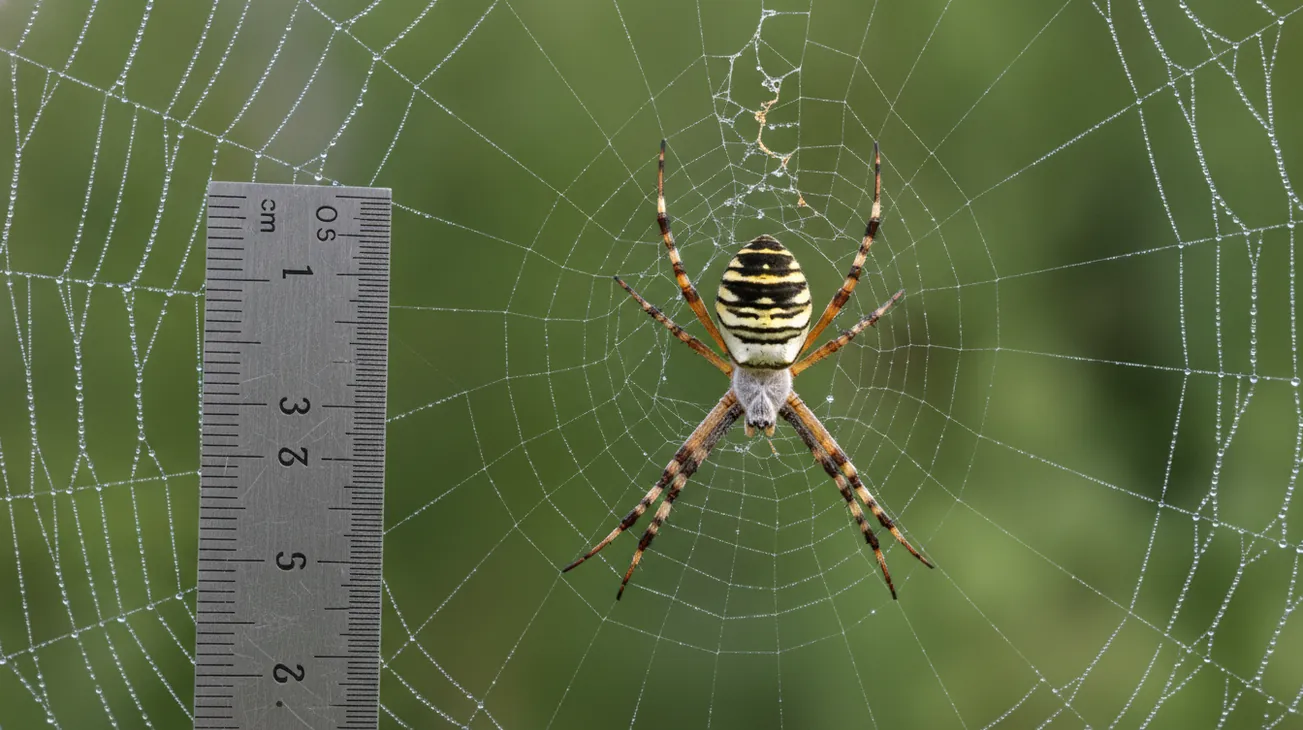
Every identification has to fit the species' known range, so appearance alone is unreliable. Note where you found it and whether it was indoors or outside. Size is the other missing piece. With no scale in the frame, a spider could be as small as a coin or as wide as a hand, so lay a ruler or coin next to it.
Spider photos that an identifier can work with
Good photos do more for your result than any app does. Work through these steps, and keep your hands away from the spider throughout.
- Photograph the spider without touching it.
- Take a sharp top-down image that shows the entire body and all visible legs.
- Take a front or close image of the eyes, if that is safe and possible.
- Photograph the web, the retreat or the immediate habitat.
- Add a ruler or another object of known size.
- Record the exact location, the date, whether you were indoors or outdoors, the habitat and what the spider was doing.
- Submit the image and your notes to a community platform or a regional museum or university expert.
- Compare the suggestion with authoritative regional references.
A blurry shot, or one that shows only the abdomen, wastes the whole effort. If you must choose, pick the sharp top-down view first. It shows body proportions and leg arrangement together.
Spiders that get confused with each other
Most wrong IDs come from a few repeat pairings. This table lists the ones that cause the most trouble and the clue that separates each pair.
| Pair | What separates them |
|---|---|
| Orb-weavers and long-jawed orb-weavers | Both may build orb webs. Long-jawed orb-weavers are generally more elongated and long-legged, while many orb-weavers are rounder and sturdier. |
| Crab spiders and jumping spiders | Crab spiders commonly hold the front legs sideways and ambush prey. Jumping spiders have prominent forward-facing eyes and hunt actively. |
| Wolf spiders and funnel-web weavers | Wolf spiders have conspicuously larger forward-facing eyes. Funnel-web weavers have eight eyes closer in size. |
| Black widows and false widows | A rounded abdomen and dark color can occur in both. Compare markings, body proportions, web, sex, geographic range and surface appearance. |
| Garden spiders and other orb-weavers | Yellow and black coloring with a large round web suggests a garden spider, but other orb-weavers can share the markings and the conspicuous web decorations. |
Why a violin marking does not make a brown recluse
This is the most common mistake we see in spider questions. A brown spider with a violin-shaped mark is not automatically a recluse. The Burke Museum and Spider Mentor both stress that the marking is not enough. Recluse spiders have six eyes in three pairs, and a definitive identification may require microscopic examination. If your photo can show the eyes clearly, that tells you more than the mark on the back. If it cannot, call it a brown spider of unknown family and leave it there.
Spider ID apps, sites and experts compared
You have several routes, and they work best in combination.
- iNaturalist. A free community-science platform where other observers can check and confirm your identification. That human check is what the automated tools lack.
- Automatic Spider Identifier. An Android app reported to return five likely scientific names for a photo.
- Fieldbook. A nature-journaling and identification app that suits keeping a record of what you find.
- Insectio. A web-based bug and spider identifier that uses your location as part of the identification.
- Lens AI, ScanaBug, Spider Ace and similar apps. These offer automated or community-assisted suggestions. Published accuracy figures for them are scarce, so use them for a lead, not a final answer.
- Regional museum or university arachnologists. The right call for a difficult specimen, or any time a species-level answer matters.
For a medically, legally or scientifically important identification, keep the original image and get specialist confirmation. A screenshot of an app result will not carry any weight with an expert.
If your photo turns out to show something other than a spider, the bug identifier page covers insects and other small animals. Birds are in the bird photo guide, legless reptiles in the snake photo guide, and ticks on the tick identifier page. Chewed leaves point to the plant problem and pest damage guide, and striped or hairy larvae to the caterpillar, butterfly and moth guide. For flying insects that look alike, see how to tell bees from wasps. You can also start from the picture identifier on the homepage when you are not sure what kind of thing you have found.
Spider bites, handling and sharing photos safely
Do not handle, pin, trap or disturb an unknown spider just to get a better photograph. Do not assume a spider is medically significant from its color or a single marking, and do not use a photo to diagnose a bite or choose a treatment. Bite risk cannot be read from a picture unless the species and the circumstances are verified. If a bite causes severe or worsening symptoms, seek medical care. Species identification from a photograph is not a substitute for medical advice.
The legal side is simple. Photographing a spider is generally low risk. Going onto private land, protected habitat or restricted areas for a specimen can be unlawful, and the rules vary by place, so check local rules before collecting.
Think about what the photo gives away, too. Do not post a precise home address, a child's image, personal metadata or an identifiable room inside your house alongside it. For rare or protected wildlife, exact coordinates can invite collection or disturbance, so use the location-sharing controls on whatever platform you post to.
Spider misidentifications and their causes
- Going by color alone. Color shifts within species and overlaps between them.
- Accepting one matching internet photograph as proof.
- Ignoring geographic range, so the answer is a species that does not live near you.
- Shooting a blurry image or photographing only the abdomen.
- Leaving out scale.
- Assuming every eight-eyed spider belongs to the same group.
- Calling a spider a recluse because it is brown or has a violin-shaped mark.
- Mixing up a likely family with a confirmed species.
- Killing or removing the spider before taking photographs, which leaves you nothing to identify.
- Treating an automated app result as expert confirmation.
Fix those and your next photo will already be a better one. When an answer matters, send the images and your location notes to a person who handles spiders for a living.
Questions about spider identifier
Can I upload a picture of a spider to identify it?
Yes. Upload a sharp top-down photo to a spider identifier, iNaturalist or a regional expert. Include scale and location, and treat the answer as a likely family or species, not proof.
How many eyes do spiders have?
Most spiders have eight eyes. Recluse spiders have six, arranged in three pairs, which is one of the clues that separates them from similar brown spiders.
Are house spiders venomous to people?
You cannot tell from a photo. Bite risk depends on a verified species and the circumstances, so do not judge from color or one marking, and seek medical care for severe symptoms.
Does a violin marking mean a spider is a brown recluse?
No. The Burke Museum says a violin marking is not enough. Recluses have six eyes in three pairs, and definitive identification may need a microscope.
What photos do I need to identify a spider?
Take a sharp top-down shot of the whole body and legs, a close shot of the eyes if safe, the web or habitat, and a ruler for scale.
What is the best way to confirm a spider identifier result?
Treat the result as a hypothesis until an expert or several qualified observers confirm it. Submit your photo and notes to a community platform like iNaturalist or a regional museum or university expert.
Are spider identification apps accurate?
Accuracy varies and is rarely published. Treat an app result as a hypothesis until an expert or several qualified observers confirm it, especially when species matters.
Is color enough to identify a spider?
No. Color and pattern vary within a species and overlap between species. Eye arrangement, body shape, legs, web type and geographic range give stronger evidence.
Sources
- Burke Museum, spider myth: ID from a photo
- Burke Museum, spider myth: you can identify spiders by looks
- Burke Museum, looks just like myth
- Burke Museum, spider identification is easy myth
- Spider Mentor, photo ID please
- Lilach Bullock, best spider identifier apps
- Ray Fraley, field notes on spiders
- Online Field Guide, spider identification chart