
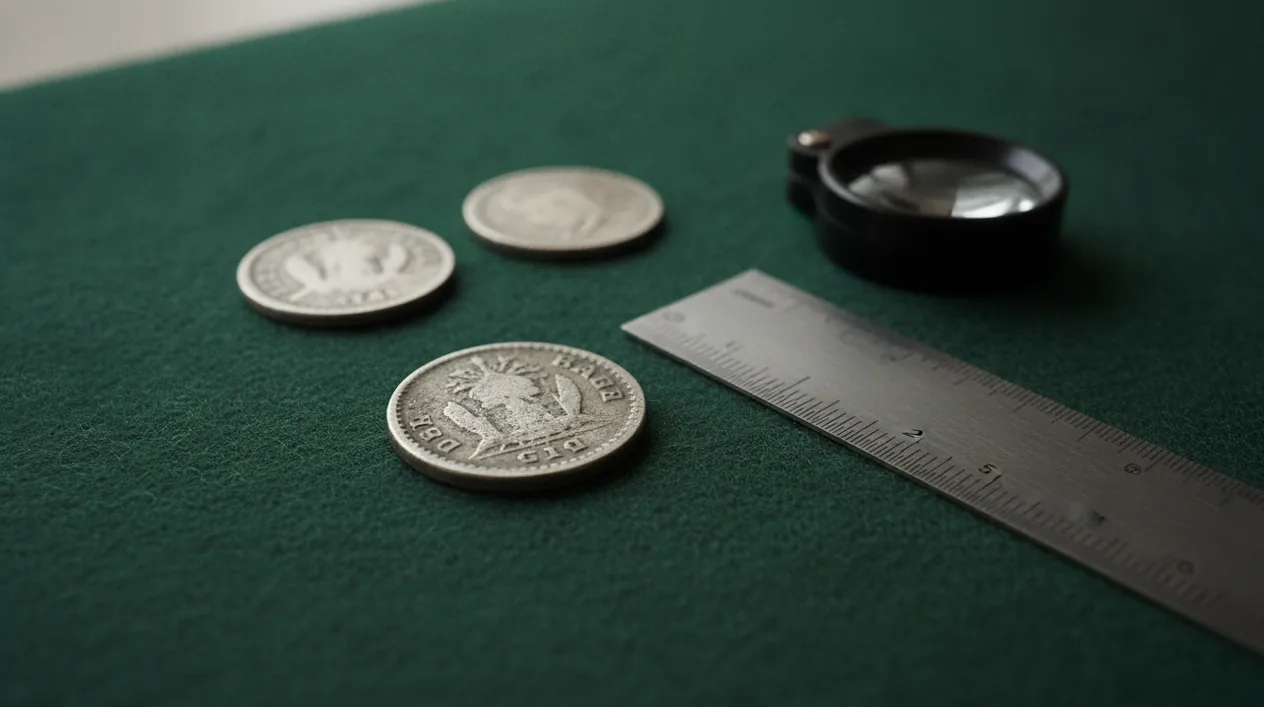
Coin photos: what shows and what stays hidden
A photo can usually pin down a coin's country, denomination, date, mint mark and design type, and sometimes a possible variety. That answers most of what people type when they search for the coin they found.
It cannot reliably prove metal composition, authenticity, grade or market value. Any coin scanner result, ours included, is a candidate match and not a confirmation. Hold onto that, because it shapes everything below.
Photo-based tools weigh relief, inscriptions, date shape, diameter cues, edge details, mint marks and the reverse design against reference databases, according to the developers of coinidentifier.io and CoinScribe. Image-recognition tools rank likely matches. They do not issue a verdict. Accuracy also depends on what the picture shows, so the quality of your photo counts for more than which tool you pick.
The shots to take before you identify a coin
Take these shots first. Most failed identifications trace back to a missing one.
- Both faces. Many coins share a similar portrait or symbol on one side, so the obverse alone can mislead you.
- The edge, on its own. It may be plain, reeded, lettered or decorated, and edge lettering can separate similar coins.
- A ruler beside the coin. Scale helps separate coins, tokens, medals and similar denominations. Calipers work too.
- The full rim and every inscription. Do not crop either one.
- Sharp, even light. Avoid glare, blur and colored lighting. A shiny surface under a bare bulb hides the details you need.
Then write down what you can read, and if the lettering style is unfamiliar, try a tool for naming typefaces. Note every letter, number, symbol and mint mark, plus the exact position of the mint mark. Weigh the coin in grams on a calibrated scale and measure diameter and thickness. Weight helps with varieties and possible counterfeits, though wear and damage change it. Color alone proves nothing about metal, since toning, plating and corrosion all change how a coin looks.
How to identify a coin step by step
- Leave the coin alone. Do not clean or polish it.
- Photograph the obverse, reverse and edge in sharp, even light, with a ruler in frame.
- Record diameter, thickness and weight.
- Transcribe the letters, numbers, symbols and mint marks you can see.
- Work out the likely country or script from the lettering and emblem.
- Run the images through one or more coin-identification tools. Uploading both sides to the scanner above gives you a quick first read with a confidence level.
- Treat the result as a ranked possibility, not proof.
- Check the candidate in a trusted catalog against country, denomination, date, mint mark, composition, dimensions, edge and design.
- If the coin looks valuable or unusual, check counterfeit diagnostics.
- Grade it separately. Then compare recent sales for the exact date, mint, variety and grade.
- For a valuable, ancient, rare or suspect coin, get professional authentication.
Step 8 is the one people skip. The tool gives you a name. The catalog tells you whether that name fits your coin's dimensions, edge and mint mark. If the two disagree, trust the catalog and your own measurements.
Reading the clues on a coin
Each feature answers a different question. This table shows what to check and what it settles.
| Clue | What to check | What it settles |
|---|---|---|
| Date and lettering | Every visible numeral, word and script, plus the date system | Country and year. Worn or partial dates can change the identification. |
| Mint mark | Exact position and shape | Which issue you hold. A mint mark can distinguish issues, mintage and value. |
| Denomination | Numeral, denomination word or symbol | The coin's face value, and which lookalikes you can rule out |
| Portrait and design | Portrait, emblem, animals, buildings, stars, wreaths, inscriptions | Design type and possible variety |
| Edge | Plain, reeded, lettered or decorated | Separates similar coins |
| Diameter and thickness | Ruler or calipers | Coin versus token or medal, and similar denominations |
| Weight | Grams, on a calibrated scale | Varieties and possible counterfeits, with wear in mind |
Date worn off? Try this
A half-readable date is where guessing starts, and where mistakes follow. Worn or partial dates can change the identification, so do not fill in a year you cannot see.
Start with what is readable. The denomination and country usually survive longer than a date. Then use the portrait, the reverse design, the edge, the diameter and the weight to narrow the field. Tilt the light a little to raise the lettering, but keep it even and free of glare. A coin photographed under a sharp, low light often shows more than the same coin under a flat one.
Separating lookalike coins
Lookalikes cause most of the confusion. The fix is to compare more than one feature at a time.
| Confusion | What to compare |
|---|---|
| Same portrait, different denomination | Diameter, weight, denomination text, reverse design and edge |
| Same design, different mint | Date, mint-mark location and the exact style of the mint mark |
| Modern coin or token or medal | Whether a denomination, issuing country, date and standard coin design are present, plus size and weight |
| Coin or replica or fantasy piece | Exact inscriptions, dimensions, weight, edge and die details against a trusted catalog |
Tokens and medals deserve a second look, because a piece with no denomination or issuing country may not be a coin at all. If your find turns out to be an old object of another kind, our antique identifier page is a better starting point.
Identifying foreign coins and unfamiliar scripts
When the country is not obvious, do not stop at the date. World-coin references use the script, country name, emblem, denomination and date system together. Read all five.
The numerals may follow a different date system, so a number that looks like a year may not read as one. Write down the script as best you can, note any emblem or country name, and look for the denomination word or numeral. Once you have a likely country, the catalog search gets much shorter.
Free coin identifier tools and what each one does
There is no single tool that does everything. These are the main kinds, and what each one is good for.
- NGC Coin Explorer. A catalog of United States coins with images, specifications, mintage figures and current melt values for gold, silver and platinum coins.
- NGC Price Guide. Online price information for U.S. coins. A listed guide value is not a guaranteed transaction price.
- NGC Counterfeit Detection. Examples and diagnostic commentary for commonly counterfeited U.S., Chinese and world coins.
- AI photo apps. Coinora, CoinEd, CoinScribe and similar scanners claim to identify coins from photographs and may return country, denomination, date, mint, rarity or estimated value.
Database size claims are marketing until you test them. One coin-scanner app advertises a catalog of more than 270,000 coins, and that figure is the developer's own claim. Different databases may also classify the same coin differently, since tools commonly compare against catalogs such as PCGS, NGC and CoinTrackers. So when the stakes are real, check two sources.
The photo tool on this page is one way to identify objects from a picture, and with coins it suits a rough first pass best. The AI reads the design and lettering in your photo and says how confident it is. It does not look up prices. Prices, app coverage and privacy policies change, so check the current version of any tool before you rely on it.
A photo will not tell you what a coin is worth
For a coin you have not identified exactly, no honest price exists. Value depends on the date, country, denomination, condition, composition and the market where it sells. Grade, authenticity, demand, the venue and recent comparable sales then move the realized price. Online estimates are not guaranteed prices.
The practical order goes like this. Pin down the exact date, mint and variety. Grade the coin separately, because photograph-based grade estimates are uncertain. Then compare recent sales for that exact date, mint, variety and grade, and not for coins that merely look alike. A match on the wrong mint mark can be a different coin with a different price. For U.S. gold, silver and platinum coins, NGC Coin Explorer lists current melt values.
The same rule applies to other collectibles. Identify the exact item before you price it, whether it is a stamp on our stamp identifier page or a card on our Pokemon card scanner page.
Spotting counterfeits, replicas and mint errors
Warning signs of a counterfeit include incorrect weight or dimensions, weak details, repeating depressions and die-transfer artifacts. NGC publishes counterfeit examples and diagnostic information if you want to compare your coin against known fakes. A photo cannot authenticate a coin, and an AI result is not authentication.
Errors need the same caution. A possible mint error should match a documented production error and show consistent characteristics. Scratches, dents, polishing and chemical damage are not automatically errors. A photo alone cannot give a definitive answer, so take a suspected error to an expert before you tell anyone it is rare.
Do not sell or represent a suspected counterfeit as genuine. Laws vary by jurisdiction.
What not to do to a coin you found
Do not clean it. Cleaning can damage the surface and reduce collector value, so leave the coin uncleaned unless a qualified conservator advises otherwise. Avoid acids, heat, abrasion and aggressive chemical tests. A magnet used as the only test also tells you little, and none of these methods establishes authenticity by themselves.
If you dug the coin up, the rules matter. Ownership, reporting, export and metal-detecting rules vary by jurisdiction. Metal detecting or removing objects may be prohibited on archaeological sites, protected land, parks or private property without permission. Check local rules before you dig and before you sell a find.
Photos carry more than the coin. They can hold location data, identifying backgrounds, collection inventories or metadata. Review app permissions and privacy policies before you upload. One App Store listing for a coin scanner says the developer's privacy practices may involve handling user data, and Apple notes it has not verified that information.
For valuable, disputed or suspected-counterfeit coins, use a reputable numismatist, coin dealer or grading service. Keep any high-value sale documented and secure, with independent authentication. And if what you found is a polished stone or gem rather than a coin, try the gemstone identifier page instead.
Ways a coin identification goes wrong
Most wrong answers come from the same handful of habits. Photographing only one side is the biggest. Skipping the edge, the date, the mint mark or the scale comes next. Glare, blur, heavy cropping and colored lighting follow close behind.
Then come the assumptions. Color does not prove gold, silver, copper or plating. A token, medal, replica or foreign coin is easy to mistake for a circulating coin. Ordinary damage is easy to call a mint error. And comparing your coin with one of a different date, mint, variety or grade gives you a price for a coin you do not own.
Last, think before you post. Posting high-resolution images, addresses or collection details can give away more than you intended.
Questions about coin identifier
Is there a free coin identifier?
Yes. Coin scans here are free, three per day. Check any result against a catalog such as NGC Coin Explorer.
How do I check what a coin is worth?
Identify the exact date, mint and variety, grade it separately, then compare recent sales for that exact match. Guide values like the NGC Price Guide are not guaranteed prices.
Do coin identifier apps really work?
They can name the likely country, denomination, date and design when your photo is sharp, but they rank likely matches. Confirm the result in a trusted catalog.
Best coin identifier app
Every coin app has gaps, and all of them return ranked guesses rather than a certain match. Tool choice matters less than photo quality, so confirm the result against a trusted catalog and check two sources for important coins.
Can a photo prove a coin is real?
No. A photo cannot reliably prove authenticity, metal composition or grade. Wrong weight or dimensions, weak details and die-transfer artifacts are warning signs, so use NGC diagnostics or an expert.
Should I clean a coin before identifying it?
No. Cleaning can damage the surface and reduce collector value. Photograph the coin as found and leave any cleaning to a qualified conservator.
What coin is this if the date is worn off?
Use the other clues: denomination, country, portrait, reverse design, edge, diameter and weight. Worn or partial dates can change the identification, so do not guess a year.
How can I tell a coin from a token or medal?
Check for a denomination, issuing country, date and standard coin design, then measure size and weight. A piece missing those features may be a token or medal.